Showing posts with label Dungeons & Dragons. Show all posts

Friday, April 7, 2023

Dungeons & Dragons: Honor Among Thieves is probably my favorite movie thus far in 2023.


I've now seen Dungeons & Dragons: Honor Among Thieves twice now in the theater. It's a superb movie, and I strongly recommend you go and see it. It is worth full price. Now for my spoiler-laden review. Sorry, folks if you haven't seen it. But now's your time to head out if you intend to watch it on your own.

I want to begin by saying that I think I've waited a long time for this moment to arrive. Dungeons & Dragons has never been more popular than it is now, and I'm actually not sure what happened to create this popularity. But walking into a game store on Wednesday evening here in Salt Lake, I was amazed to see that there were four tables packed with people busily playing it, and they encompassed all ages. I've never seen that before, and it felt really self-validating to be part of a phenomenon that seems to be so important to so many kinds of people from all walks of life.

D&D has also not been without its stumbling blocks. The parent company of D&D named Wizards of the Coast has tried to license its intellectual property before for movies, and these have all been disastrously bad. What happened with Honor Among Thieves though was that it was clear that the director knew what kind of movie they were making and decided to embrace the silliness and fun of it all rather than try to make some high fantasy that would stand on the same shelf as The Lord of the Rings. The movie was constantly poking fun at itself, and that was its charm. Enough so that when the serious moments did arrive, they landed perfectly and with poignancy that left me verklempt at what I was watching on the screen. Honestly, the storyline for this thing is a real gem, especially if you are well-versed in the lore of Faerun (the D&D world in which most of their materials reference). However, if you don't know anything about Faerun, that's okay. They give you everything you need to know in the movie, and it is handled so expertly that it doesn't come across as an infodump. Rather, it is wildly entertaining.

Looking back on my viewings of the movie, I think that my favorite part of it was the resurrection of Holga, who is the barbarian main character played to a tee by Michelle Rodriguez. Her story arc is a full circle of carefully interwoven emotional moments thick with loyalty and heartbreak and then peppered with strong symbolism. For example, a dragonfly that you see throughout the film comes to represent Edgin's (Chris Pine's) deceased wife. In a touching moment in the movie, it is revealed that Edgin tried to catch one that had strayed into their home in some quaint village called "Rock Bottom." But rather than catch it, his wife tells him that the secret is to just open a window and then the dragonfly finds its way outside. She tells him something like, "You need to just let it go."

Well when Holga suffers the same fate that killed his wife, Edgin has to make a choice with a powerful magical item he procured that can only bring back one person that he loves dearly. It can either be his wife (the driving force behind Edgin's decisions for the entire movie), or he can choose to bring back his best friend Holga, who has always been there for him and helped him to raise his child. Edgin (the bard character played by Chris Pine) grows so much in this one scene in the film, and it's an incredibly attractive and satisfying thing to observe (when a character experiences emotional growth). And then Edgin sees a dragonfly, and he makes the decision to bring back Holga because he knows he needs to let the memory of his wife (which is all that she is now) go.

This kind of storytelling that loops back on itself seems like it would be easy. But having written books, I can tell you that it isn't. A lot of the times it can land cheesily or it is difficult to pull off with any kind of style. The Honor Among Thieves cast manages to land this thing with apropos grace, and I think they are able to do this because they have the audience laughing along with them in so many other areas of the film that (by the time this moment arrives) the audience is now ready to accept something serious, poignant, and beautiful.

Friday, January 13, 2023

The bizarre and angry culture war of Dungeons & Dragons is in a meltdown over the new Open Game License.

There is a bizarre and angry culture war going on in the Dungeons & Dragons community. Those who prefer old school Dungeons & Dragons are profoundly conservative and libertarian (it's weird that politics can be so easily seen but there it is). Some are as right wing as you can get, making the likes of Sean Hannity look like Obama by comparison. With a population base that plays D&D equal to about 55 million, I think of these folks as a hundred thousand or maybe a couple hundred thousand of that total. So, I think they are a small group. But they are the storm the capital on January 6th types, and they are very vocal, abusive, and the "don't tread on me" crowd.

The things that these conservatives love about D&D is the exhilaration of an open world. They prefer inherent uncontrolled chaos, spontaneity, and vast opportunity in a sandbox-styled campaign. They think this is exciting because anything could happen. Your character could get killed in the first encounter or eventually wind up as a king. They want things to be difficult for the characters, but the people running these games who stress that these difficult conditions are the proper way to game...are themselves extremely lazy storytellers.

Many of them call an hour of prep time as sufficient. They don't invest in props or models. They don't spend a lot of time reading modules or other source materials so that they can make their worlds more interesting. They basically just "mail it in." When running games, they don't give out magic items and are extremely vigilant regarding any kind of power creep because they want to be able to just pick up a game and prep in five minutes. They shut down ideas, actively work against players, and ignore rules to substitute their own that almost always castrates a character class even further on what it can do.

While running a game, the monsters they use to challenge players will be difficult if not impossible to defeat, which (in their minds) makes the experience more realistic because the stakes will be your character's life. In their worlds men have toxic masculinity traits galore, women are love interests, and there are no queer characters and anthromorphized animals (no furries!). It is a strange thing to watch when these people meltdown online because they can't find players. It's like watching the business owners complain that "No one wants to work," when these businesses are offering shitty jobs with low pay and no benefits. They should say, "No one wants to be exploited anymore. Damn, I miss the past when I could exploit people whenever I wanted." But yeah...times have changed. People have wised up. And we are all paying the price for that with inflation and scarcity. I suppose what I'm saying is that it isn't easy to make a world where everyone is respected and cared for, but its worth it. It's super easy to make a world where a few get all the goods and everyone else exists in misery. A lot of humans like the easy way out.

By contrast, those who play newer RPG's tend to be liberals. They want inclusion, tons of choices, things decided ahead of time, equitable, balanced, and fair encounters. And they want sustainable progression and a more predictable world to play in. The DM's for these games tend to put in a lot of work, carefully building worlds that make sense, and accounting for power creep by adjusting and tweaking encounters so that they challenge but do not crush players. It's kind of a "Wizard of Oz" trick in that there are smoke and mirrors in play. The DM knows that the characters are supposed to win. Their job is just to make it so that it isn't obvious that they are winning. But yeah...the deck is stacked in the player's favor, and everyone then has a good time. These people, who number in the millions and who are fans of the game, get shouted down a lot by the angry and very vocal conservative players who seem to be getting more filled with rage at what the parent company, Wizards of the Coast, does every day.

Recently, WOTC announced a big change in the way they deal with third party content using the "Open Game License" that has been pretty much taken for granted for more than twenty years. There are a lot of players who escaped the drudgery of the brutal capitalism they adore to put themselves in a position where they charge for content. But they have no empathy for those who still have to work in drudgery rather than doing something that they love. These "content creators" say to those others, "Hey! Adapt or die! I adapted! If you want something you gotta stop being a snowflake and just go out and put in the hard work like I did." But the thing is...they didn't really do hard work.

What they did was founded small corporations that churn out endless amounts of third party content. Many of you reading this blog are writers, and writers these days (especially self-publishing ones) number in the millions. Creativity is cheap y'all. It is not a precious resource. Now, as a consumer of some of this third party content, what I do choose to buy is well thought out and has good production values. But all of it is still just a money grab from the Dungeons & Dragons nerd community. Kickstarters have exploded to the point that it is getting harder and harder for new people to make any money, because the third party creators have flooded the landscape trying to make a buck.

Some of the more successful ones generate hundreds of thousands (or millions) in profits. All of these bootstrapping, entrepreneurial types are now on notice as WOTC is going to demand tribute from anything over $75,000 a year, and there are draconian rules that will allow them to claim as their own any content you create that uses their parent game system. It's all meant to secure their intellectual property, but the "content creators" and by and large their libertarian supporters who yell "don't tread on me" are (in a word) furious. And it has gotten so bad that I've had to dump several Facebook groups that (as far as I knew) existed to connect people and allow them to find players for local tabletop games. These have now all been inundated by YouTube posts saying WOTC is a money-grubbing evil monster, that D&D is being destroyed, and going so far as to say that everyone who plays is under threat. I've been shaking my head, saying, "This is the stupidest thing I've ever seen."

For years, these people have (by and large) been jealous and bitter of WOTC's success in the explosion of popularity in Dungeons & Dragons. They are stern gatekeepers as well. They wanted people to play their old, ruthless, uninteresting games with no diversity and celebrating the white male, and they called anyone who didn't want to play like that a "snowflake." Many (for lack of finding anyone who wanted to play their increasingly out of touch games) switched to the fifth edition only to proceed to lambast, strike out rules, and criticize the ruleset completely in an attempt at the old "bait and switch." The thing is, new players don't like to have their free time being abused by another human being, which is how a lot of old school D&D tends to be.

They also promote hysteria in the same manner as conservative talk radio promotes hysteria by floating conspiracy theories and by making mountains out of molehills. As a longtime player, I've never been more aware than I am now at the stark differences between how conservatives and liberals define what "fun" is and how they prioritize what is important and what isn't important. I don't actually know where it will all end up. What I do know is that the Open Game License in any iteration is a benign thing to people who just enjoy playing the game, and that the outsized cries of anguish are from people who are making money at D&D content, which is just plain weird. I get that community is important. But trying to monetize a hobby is some sketchy crap to pull, and I think that maybe if you are that kind of person, you should try working like the rest of us in drudgery and the capitalist system that you voted for and created. It's hard for me to shed any tears for any corporation or group that thinks that they had a right to build upon Wizards of the Coast's intellectual property without paying them their pound of flesh.

So anyway, that's what's been going on in the Dungeons & Dragons community. I'm interested to see how it all ends up. I enjoy the game a lot and I always have. I think the game will be better if  many of these "content creators" just move along and develop their own systems. If they choose to do this, then good for them. I'm just getting tired of the social media posts that are everywhere in the groups I'm in declaring, "I'm going my own way because I've been stabbed in the back for the last time by Wizards of the Coast." I'm like, "Please do and don't let the door hit you on the ass on the way out." However, if I like what they make, I just might buy a copy and start playing their game. I think that will be healthier for everyone, and maybe my Facebook groups for "finding a group" can return to normal instead of constant demands to sign "this petition or else!"

If only we lived in a world where people could just admit freely that there are only so many good ideas, and that if you are a corporation that comes up with the "good idea" that it would be okay to eliminate your obscene profit in said idea (we'd all have to settle on some threshold that would make you rich but not obscenely rich as a reward) and let everyone have a piece of that pie forever after. So yeah...socialism. Expect anything else from this democrat? But I know we don't live in that world, because people are still gaslighting themselves into thinking that there are infinite good ideas and that if you can't come up with one, then you are stupid and deserving of your failure. This is categorically untrue, but whatever. All of these "content creators" who go off and design their own game are about to find that out, as many of their companies fail to generate the profits necessary to sustain their business.

On Wednesday of next week, I want to talk about Netflix's Locke & Key. See you then.

Monday, August 22, 2022

Dungeons & Dragons is making some minor revisions to its popular ruleset and it's caused a meltdown online.

This last week has been an interesting one for the tabletop roleplaying game community. Wizards of the Coast, which is the parent company for Dungeons & Dragons (and a very well run company I might add), has decided to produce an update to the core rules which they believe stand the test of time and will only require minor updates every few years. For decades, this has not been the case. Every five years or so, a new edition would roll out with all new revamped rules that would irritate old school players who would feel like they get left behind, and it would irritate those who have tight budgets as replacing books is expensive. This new approach...to make a ruleset that is backwards compatible and makes a few tweaks here and there that you can either accept or discard depending on how you want to run your game...has started a lot of discussions. And many of these discussions could be rephrased as complete and total meltdowns online. It's a fascinating thing to see how people enmasse react to a changing world, even if that world is fictional.

For one, a lot of the changes are being branded as "politically-inspired bullshit" or "wokeness gone too far." Wizards of the Coast has decided that it is in their best interest to be as inclusive as possible. So, they have made tweaks to races to make them pretty much equal to one another (which was not the case before). They have also created hybrid races that can more safely explore the fantasies of those people who identify as "furries" to allow them safe spaces and a means to create all kinds of animal and human combinations. Queerness of all kinds is represented. There are gay heroes and rulers of countries of fictional worlds. And there are black, brown, female, and disabled characters being represented. It pisses a lot of old school (particularly white male) people off. So why has this come to pass?

Look, Dungeons & Dragons has always been a weird form of entertainment. But its mainstream appeal in 2022 is pretty gigantic, and there are so many new people playing and wanting to play this game that I have enjoyed for decades. I like to think that the reason this has happened is because of the inclusive changes the game has made. But another reason might be that the escapism that D&D offers is a substitute for therapy which many cannot afford. Some of the old school complaints that I don't agree with which are aired online is the fact that Wizards of the Coast is supporting people creating and indulging all kinds of fantastical worlds, instead of adhering to the patriarchy-driven European middle-ages kinds of fantasy stereotypes that grew from works like The Lord of the Rings and continued through Game of Thrones and every other kind of medieval fantasy knockoff. In other words, in the eyes of many of these people you are not playing proper Dungeons & Dragons if your idea of a fantasy world looks more like Disney's Zootopia and less like Middle Earth.

This is a weird take, right? Additionally, the company has decided that the alignment system (which you may have heard of) is extinct. No longer are things "Chaotic Evil" or "Lawful Good." Instead, they want evil and good to be a matter of play and decision-making and motivation, rather than a label you just smack onto something. It is an interesting way to go about doing things, mostly because it assumes that people are smart enough to know when something is evil and something is good. We should all realize that this idea doesn't work, as the pandemic showed us that no one does "the right thing." We either assume to believe this truth, or far worse, to believe that people simply do not know what the "right thing is" to begin with. Labels like "Chaotic Evil" were useful to just stick onto things for those people (who are many) who have no ability to judge whether raping a thing is good behavior or not (if you are in doubt...it is not). And in my own personal experience, I plan to continue to label things for players who may have trouble sussing out whether a thing they decide to do is evil or not, and whether observing something occurring is evil or not. Sometimes, people truly are stupid enough that leading them around a bit is the best way to go. Although a good storyteller can accomplish this without making it too obvious (and that is the key, isn't it?)

There are also minor rules changes that are coming up. Some of the things that people previously used will lose relevance as the new things get printed, but I think it is all in good spirit as the streamlining clears up misunderstandings. What I don't get is the hate that I see from old-school players, who didn't embrace the latest edition of the game anyway, and are continuing to struggle to find players for their games that they run where the rules system hasn't been updated since the 1980's.

From reading their Facebook posts in a Facebook group I belong to, you would think that the company is a complete sellout to liberals, and that the new generation of players are all weaklings who got participation trophies in school and who cannot handle the harshness of a gritty game. They are half right...no one has the stomach to play games where characters experience nothing but misery and then die. What's the point of that? What's the fun in that? But there are (in this old school crowd) plenty of people who get enjoyment from watching characters suffer.

It's an odd phenomenon, and I wonder why this is. Is it inherent within human nature to want to watch others suffer, even if those suffering are fictional characters? Is this (perhaps) why dystopias are so popular in fiction? I suppose it is all good as long as you don't expect someone to inhabit the skin of that character that is suffering. And this (at its core) is what Dungeons & Dragons does: it puts you in the skin of a character. And considering that its a game, it is supposed to be fun to be that character for a few hours. And fun (the last time I checked) had nothing to do with suffering unless you are a really odd duck.

In any event, I wish I understood why people get so upset at changes. I wish I knew why people get stuck in tar pits like dinosaurs did in prehistoric times. They get stuck there, and then they die in the sweltering sun. It doesn't make sense, especially when I find out that many of these people so resistant to change say to my face that they are capitalist. Capitalism, by its very definition, embraces innovation and change. If they hate innovation so much, and they can't afford to replace books, and they hate it when a company makes something irrelevant, they should be a socialist. But they aren't, and that confuses me a lot in just about everything I observe them doing. Instead, they just want to keep going forward (and expect everyone else to go forward) with ideas that they embraced when they were young, like an insect frozen in amber. I suppose it is easy to confuse "what is" with "what ought to be" when "what is" has been working in your favor for so long.

If you have the time, you should watch the video above. It's quite interesting, and it will give you a bit more perspective on the changes that are happening in the community (and why some people might be outraged).

Friday, July 1, 2022

Dungeons & Dragons is exploding in popularity and I think it is being driven by a mental health crisis.


I had a somewhat strange experience on Wednesday evening. A couple friends I made at the local game store invited me down to what they call a "session zero" designed for people to talk about the content of a tabletop roleplaying game like Dungeons & Dragons, and to discuss woke topics like 1) representation, 2) sexual content, 3) pronouns, and 4) things that trigger people. I'd never attended one of these, and I was surprised to find the table completely packed with over ten people (way too many for a game) all outlining their expectations for a tabletop RPG.

This was something I had never seen before, and at the risk of sounding like an old fart who yells at cloud, I thought it was kind of disturbing. I'm a liberal and a democrat. However, I'd be considered far right to some of these folks. It's very strange to see how sensitive people are in their interactions with others, and how much expectation they heap upon someone who just wants to get a game together with another person for the purpose of having fun. Folks, making friends has gotten very complicated.

The other shock of the day was that there was literally no room for me to play. So I'd have to look elsewhere to find a game. This puzzled me for a little while, and then I realized I'd been noticing this phenomenon more and more since the pandemic. Additionally, it suddenly hit me that the grocery stores I've been shopping at have not been as crowded lately. It's a combination of high prices (out of control inflation) and a crisis in mental health.

People (I believe) are scared, and they can't afford to go on vacation. They can't afford a lot of things, and so they are seeking out free entertainment like someone running a D&D game at a game store. Dungeons & Dragons has always been escapist. This latest phenomenon of tons of people overwhelming what few Dungeon Masters there are to go around looks a lot like, "I need something to escape the world in which I live." In other words, these tabletop RPG's have become a kind of therapy, similar to smoking mushrooms when you have PTSD. 

And in case you are wondering why this might be necessary, I have a friend who is on a waiting list for a therapist that is 8 months long. Given the amount of trauma being visited upon a large portion of the United States in the form of authoritarian edicts from the Supreme Court, coupled with climate crisis, gas prices that are the highest I've ever seen, and housing prices that are in the stratosphere, I think I can completely understand why people are seeking to escape...to flee...anywhere that they can. These are very strange times. I've never seen so many homeless people. They are everywhere in my city in places you would not expect. There are huge tent cities on sidewalks all throughout downtown, and there is litter and needles tossed on concrete and asphalt to just bake in the intense sun (everything is hotter and drier too). 

Anyway, it's just another hypothesis caused by another observation that I've made. I have no idea what it all means. The bigger picture is elusive, and I feel like I may paint things with too broad of a stroke. But I think that Dungeons & Dragons is exploding in popularity, and I believe it is being driven by a mental health crisis from which many people have no escape.

I'll be taking the 4th of July (Monday) off from blogging. Have a great weekend. I'll see you back here next week for the Insecure Writer's Support Group post.


Friday, April 22, 2022

Spelljammer is being rebooted for 5th edition and I'm so excited by this news.


I'm here to show all my inner nerd peeps. I apologize in advance, and this post is going to be about Dungeons & Dragons which is the nerdiest of things to do with one's free time. So as your eyes glaze over, and say..."I just...can't with this D&D stuff..." that's okay. I'm going to geek out here on my blog for this Friday and try to return to a semblance of normal blogging next week.

Without further ado...Wizards of the Coast (which is the company that owns Dungeons & Dragons) held its first ever D&D Direct web conference. This is a digital news release/conference/presentation meant to illuminate all things Dungeons & Dragons that are coming out in 2022.

First off, the biggest news was that they are bringing back the Spelljammer setting. If you don't know, Spelljammer came out during second edition, which had its heyday in 1990...so thirty years ago. I own all the supplements for that game, and as they are getting kinda faded and yellow with time, I was wondering if we'd ever see a modern ruleset (D&D is currently on its very amazing 5th edition). So, you might ask: why has Spelljammer got me so excited?

The Spelljammer setting had ships like this.

Well, the most popular D&D settings for games and stories are ones inspired by European folklore. They are kind of "Lord of the Rings" knock-offs if you will. Spelljammer was way different. It involved traditional sailing ships that had been empowered by magic so that they could fly through the void of space. You could explore different worlds, have space battles, and "space" itself was filled with all kinds of magical wonders. It also allowed your characters to travel from one setting to another that was akin to traveling to different universes. You could have space pirate adventures too.

Furthermore, Wizards of the Coast is going all-in on this product. The Spelljammer campaign setting is going to be a three-volume set complete with a handsome slipcase and a double-sided map and a screen to use while gaming. And the whole thing runs just $70.00. That seems like a lot, but it isn't for three full-color books, a map, and a screen. That's less than $25.00 per book, which is peanuts these days given how it now takes me $75.00 to fill up my truck with gas.

The first of the three volumes is titled the Astral Adventurer's Guide. This is going to be the main book and contain everything a DM (Dungeon Master) would need to run a campaign as well as tons of options for playable characters. The second book is called Boo's Astral Menagerie, named after a giant space hamster from one of the D&D video games. We're going to get evil space clowns, vampirates, sentient comets, and space dragons. 

The last of the three volumes is called Light of Xaryxis. Set in the astral sea (an even more magical place in the setting than normal magical places) it includes 12 adventure hooks, each of which end in a cliffhanger. This thing ships in August, and I'm so excited to get my copy.

All of that being said, there was other news mentioned in the webcast. For one, the Dragonlance setting from famous fantasy writers, Weiss and Hickman, is coming back as a board game that will include some kind of campaign module that you can play called Shadow of the Dragon Queen. A board game sounds intriguing, especially if it has cool miniatures. A module (as well) is extremely exciting as Wizards of the Coast has been knocking things out of the park with their modules in the last few years. These are fully integrated adventures that generally take characters from level 1 to level 10 and have enough playable material to last six months or more. And the Dungeons & Dragons movie that is in Hollywood and stars Chris Pine now has a title: Honor Among Thieves.

Anyway, there's a lot to be excited about regarding my hobby.

Monday, April 11, 2022

Dungeons & Dragons does not need NFT's but they are coming anyway because people suck


A company called Gripnr wants to create their own NFT Dungeons & Dragons market, and I just have no words for how stupid this sounds. But undoubtedly, there will be people who see value in it. I just don't know why. Here's the business proposal in a nutshell that is being talked about. Players will buy a pre-generated D&D character created by a computer or something else. This pre-generated character will exist on the blockchain, which is where NFT's and crypto are all encoded. They will play with this pre-generated character under an approved Gripnr "Dungeon Master," who (I assume) is skilled at running the game. I also think it will be virtual, but you never know with these things. The blockchain "character" will then go through pre-generated adventures that I assume will also be monetized on the blockchain. They will earn experience, level up, and obtain both a history and magical items. Who knows, they may even acquire "land" in a blockchain "fantasy world" set up for D&D. And then, anyone that wants to use your character's likeness or your character's name or anything else would seemingly have to pay you for that right. Additionally, other people could play the character you created but they'd have to pay you for that, because you own it.

I should point out that Gripnr is not a maverick in the Tabletop RPG industry. Rather, it's a pet project attempting to exploit a hobby that I very much enjoy. The thing is...no one is asking for any of this. The TTRPG community has already been monetizing pieces of creative output for years in the form of modules, adventures, books, miniatures, commissioned art, terrain, and dice. So, there's a proven track record that people want to put more of themselves into the game than you can with core assets alone (furnished by the parent company of Dungeons & Dragons called Wizards of the Coast). So the question that pops into my head is: why would I even want to buy an entire character off the Gripnr blockchain when creating and building a new character (for free), watching them grow, and then interacting with a fantasy world created by an imaginative friend is the whole point of Dungeons and Dragons!? Ay carajo!

The world is increasingly becoming a strange place where everyone seems to want to monetize everything. As soon as someone can figure out how to charge us for the air we breathe, that will probably come next. I just get so angry at all the rampant greed that I see everywhere. Anyway, I wanted to finish this little post with a note that Wizards of the Coast is not involved in any of this. You may not know that, but Wizards of the Coast (which is a very good company) owns the rights to Dungeons & Dragons, but it has this "Open Game License" thing which allows tons of people and other companies to use their intellectual property to create stuff. I think this is really neat. So there are all kinds of third party monster manuals and supplements and other things that use the core set of rules that the geniuses at Wizards of the Coast created (and they work really well). It just sucks that a company like Gripnr comes along and wants to use the Open Game License to start some unnecessary crap that ultimately will benefit no one. I actually hope that (if it launches), that it actually fails and is forever known as a terrible business model for a hobby that doesn't need these kinds of transactions.

Chalk this post up to another "Old man shakes fist at sky" thing I suppose.

Monday, February 28, 2022

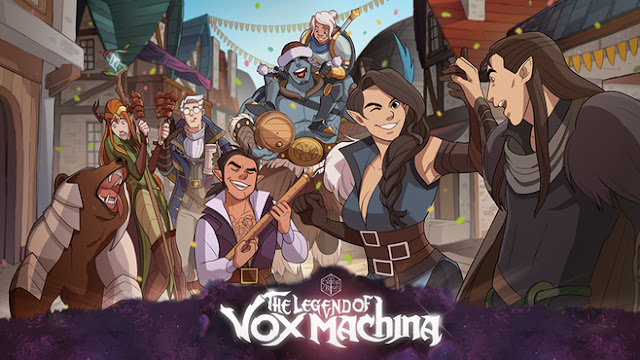
The Legend of Vox Machina is an outstanding animated series for Dungeons & Dragons.


I finished watching the Legend of Vox Machina on Amazon, and I decided to talk about it on my blog. Lucky you, right? So, if you are unfamiliar with this work, it is an animated series based-on Matthew Mercer's Dungeons & Dragons campaigns that are aired on his YouTube channel called, "Critical Role." Matt Mercer is kind of a B-List or maybe even C-List celebrity. He's a handsome guy that has talents in voice acting, and an obvious love of D&D. And he plays with people who are equally talented, like Felicia Day. But he's not the kind of actor that headlines movies like Tom Holland does. Rather, he's several pegs down the chain of Hollywood, mostly filling in on projects here and there (kinda like Joe Manganiello who may be a slightly bigger celebrity due to his wife Sofia Vergara and his obvious connections to powerful nerds in Hollywood, like the producers of the Game of Thrones series and being friends with Zach Snyder). Matt Mercer isn't "big" like that, but maybe more on the lines of Wil Wheaton. But that doesn't mean he isn't well connected and that he doesn't have millionaire friends with some measure of influence in the entertainment industry. Obviously, he's got an excellent agent, and they were able to get Amazon to put up the money to make Legends of Vox Machina into an animated series. That's a pretty major achievement.

Legends of Vox Machina was super entertaining, and I'm so glad that a person like Matt Mercer is pushing my hobby of many decades into the mainstream. There are many things I loved about the first season, so I'll try to boil it down. First, Legends of Vox Machina took the subject matter seriously (fantasy is nothing to laugh at folks), while still making it crazy fun by playing on tropes that real players do with their characters in tabletop games all of the time. If you don't understand what I'm saying, let me put it this way. When people ask me the question: what is playing Dungeons & Dragons like? I usually respond with, "It's like really bad improv but with dice rolls."

My favorite character by far was the bard, who was so over-the-top with his character that he wore a rainbow colored codpiece in one part so as to "distract" the crowd enough for his teammates to perform an important action. I also loved the LGBTQ representation, and the world seemed very woke without making it come across as heavy-handed. It managed to bring fantasy into the modern world, giving the old epic fantasy genre a much-needed update by supporting inclusion, diversity, and adopting our modern way of saying things. The F-bomb gets dropped a lot, while the series progresses as a kind of "greatest hits" on the well-known monsters of Dungeons & Dragons (starting out with a literal dragon that is badass). I'm also sure that it will have its haters from the community, mostly those people who are stuck in the mud, and who believe that things should never change from the way they were represented in the 1980's. They are wrong, of course. But it won't stop them from airing their opinions in any way possible while they watch reruns of M*A*S*H and other shows from that same era.

I suppose at its most basic level, what I appreciate most about The Legend of Vox Machina is that it is a perfect vehicle to showcase how a game like Dungeons & Dragons can make you a better storyteller. Anyone who likes to write fiction should consider getting into a game, creating a character, and then exploring a world. Sure, there are dice rolls to represent the heavy-lifting mechanics of combat, and there are many pages one has to read before one is ready to play. However, the investment is worth it because it forces you to pay close attention to the motivations behind characters. Great characters are never one-dimensional. There is a reason why they do a thing, and when you play a game, you are forced to figure out how A connects to B which then connects to C long before you even do anything. This is how you breathe life into a character and make them believable to an audience.

I also like that there are many more opportunities for people to interact with others in the "business" of Dungeons & Dragons. Here in the Salt Lake valley, I know a guy who paints miniatures for Joe Manganiello, which is honestly kind of cool. They are on a first name basis with each other. I also participate in Kickstarters for new D&D products, and I even sent a monster in last week to a contest to see if it will get printed in the next Tome of Beasts. I'm kind of excited by that, because if my monster gets picked (I won't know the results until mid-March) there's a chance that they may ask me for more details about the world in which the monster came from, and thus, I might get some other ideas published. But all of the above is possible, in part, because Critical Role has garnered such a huge online following.

Anyway, long story short, you should give The Legend of Vox Machina a try. Who knows? You may really like it.

Friday, May 21, 2021

Vignette number one from my Dungeons & Dragons game is about a watery tentacle that bestows supernatural gifts.


Here is the first of the vignette short stories that I got sent by one of my players. Her name is Geneva, and she's playing a rogue that multiclassed into Warlock. She seemed really taken by the warlock character class in the Player's Handbook which ties its power to some kind of ancient/old entity. Geneva decided that Valerie (her character) would have a connection to the ocean, as the setting for this campaign is around a small town called "Saltmarsh" in the Kingdom of Keoland.

The name of this piece is Tentacle.

Valerie wades in the surf, knee deep, in a secluded cove an hour’s walk from town. She is 8 years old. She has been swimming with her best friend, Oelien, a young elf boy around her age. He is still swimming out by the reef. She sees him surface, much less often than one would expect. She envies his ability to stay under the water for so long, but she is content to watch from shore for now. She may go back in for one more swim in awhile, but right now she is enjoying the feel of the summer sun drying her hair and warming her skin. She has plenty of time before she’s expected at home. Her mother made it plain that this afternoon she was to stay clear of the house until sunset, and her father is out to sea.

Valerie has been swimming almost since she could walk, and is quite good at it. She loves the way the cool salt water embraces her, buoying her up when she swims on the surface, surrounding her when she dives beneath. Moving through it feels the way she imagines flying would feel. She wishes she didn’t need to come up. She often opens her eyes in the stinging salt water to find a world of beauty below her. She can hear the fish feeding on the corals on the reef just past the shore break. The sound of the waves ebbing and flowing is the sweetest music to her. She can make small forays into the deeper water, but finds herself frustrated by the limits of her breath.

Sometimes the world of the water seems more real to her, more like home, than the world on land. Especially her own home, when her father isn’t there. Her mother is often preoccupied, and short with her if she’s underfoot. There are things in the house that Valerie only sees when her father is out of port, and she’s pretty sure she’s not meant to notice them. But Valerie has always noticed things. Sometimes, strange people come to the back door of the house for whispered conversations with her mom. Sometimes, those conversations take place in languages Valerie doesn’t understand. Once, when she was smaller, she went climbing up a shelf to reach a coin purse that was hanging from a high hook on the wall that had not been there the day before. She fell and was discovered. Her mother was furious, and, strangely, afraid. Afterwards, her mother carefully poured a few coins on the table and showed them to Valerie and explained to her that she must never, ever touch coins like this. The coins looked like gold coins, which Valerie had seen before, but these glinted red in certain light. Her mother swept them back into the purse, which Valerie never saw again.

The tide is coming in. Valerie is on a rocky bit of shoreline now, among tide pools filled with urchins, anemones, and purple sea stars. She crouches where the water is beginning to crash on the rocks, pulls off a few mussels from under the edge, pries the shells open, and picks out the tiny creatures inside. She washes them in seawater and pops them in her mouth. She chews, savoring the sweet/salty taste.

Now she is thirsty, and she realizes that she has left her clay water jug far down the beach, with her clothes. Oelien is still swimming, far out. She places her hands beside her on the rock and prepares to hoist herself up, then stops mid-motion.

There is a tentacle coming out of the water, right in front of her, and it is reaching for her foot. But it doesn’t look like a proper, fleshy tentacle. It’s transparent. It appears to be made of water. It touches her with a soft splash, and it feels like water on her skin, but it doesn’t lose its form the way a wave would upon impact. In the instant of that touch, a voice fills her mind. To Valerie it sings like the sea itself - thundering, beautiful, fierce, overwhelming. She can feel it swirling around inside her head, much the way a wave does across and between and under the rocks where she sits. The voice in her head is alive, and it flows unchecked into every part of her consciousness. She can’t stop the flow. It demands to know her.

Her body is standing now, her back arched, her arms thrown wide, her eyes sightless as the tentacle winds itself up her body and also into her mind. Angry now, she demands in return to know what thing believes it has the right to use her so. One who would give you the gift you want the most, child, answers the voice. One who is as wild as you want to be. One who welcomes you into the depths.

The tentacle, grown large and strong now, pulls her into the water and propels her forcefully away from shore and downwards. She struggles against the tentacle now, aware that the growing pressure in her ears means that she is going deeper into the water, and the burning in her lungs means that she will soon need to breathe. Then breathe, says the voice.

And then Valerie feels the seawater flowing across the sides of her neck, and the urge to inhale that she’s been fighting abruptly leaves her. The wave that had flooded her mind recedes until it is a lingering caress, a single tendril. A tentacle. The force binding her limbs eases. Open your eyes, child, says the voice softly. Look upon your new world.

She expects the familiar sting of the salt water as she opens her eyes, but it is absent. Her eyes quickly adjust to the light level. She is probably about 30 feet down, but her ears aren’t bothered. She is surrounded by sea life. Reds are dull and dark at this depth. Yellow and green and purple are still visible, if a little softened and blued in the filtered light. There is something swimming rapidly toward her that is roughly her size. Her friend? No. She sees a head and arms like a child’s, but then she sees its powerful, finned tail. Its skin is a sea creature’s skin’s texture and color, its movements more like fish than humanoid.

The creature is close now, so close she can see its eyes and its facial expression, which is hard to read. Curiosity? Concern? The eyes, though… it IS Oelien! Valerie thought she had lost the capacity for further surprise today. She was wrong. Her best friend is a… what is he, exactly?

He motions toward her neck. Valerie’s own hand follows the motion, and touches the side of her neck, gently, and she understands. She’s seen, and felt, something like this when helping her father clean fresh-caught fish. Gills. She has gills! The tentacle in her mind speaks. When she is in the water, from now on, she will have gills. They are the gift, perhaps the first of many gifts. She can now move between the worlds of land and

water freely instead of being an outworlder from the surface. Just like her best friend. The word the voice uses for him is one she has heard in stories. Changeling.

Valerie is overcome with a savage joy. She taps Oelien on the shoulder, and using hand motions, challenges him to a race. This time, for the first time ever, she matches his speed. They play under the sea, swimming through passages in the reef, plunging over the edge of the drop-off into deeper waters, watching motionless from below as several white-tipped sharks carve out a living ball of smaller fish from a school and feast.

After about an hour, Valerie heads for shore. She can breathe under the water and swim better than ever before, but the water is still cold, and swimming still takes effort. By the time she emerges onto the beach, her limbs feel heavy, and she’s shivering. The tentacle, as she has named the thing in her mind, is silent, but is still present in her head when she searches. She can feel it, now delicate and subtle, dipping into her experiences as they happen. Oelien comes ashore just behind her, now appearing as the elf child she had thought him to be up until this day. He is tentative around her. She instinctively knows why, and reassures her friend that she will protect his secret. She asks for the same protection in return. They solemnly link little fingers to seal their promise.

She cherishes the tentacle’s gift, yet she understands that telling any other person, especially a grown-up, might provoke reactions that would affect her in ways she can’t control. It is easy for her to imagine her mother forbidding her to go to the sea. She wouldn’t be able to stand that.

Friday, April 30, 2021

Jeff Goldblum is going to play D&D now which really does show you how much reach Dungeons & Dragons has in the world.


I'm continually amazed by the celebrities that are piling and/or coming out of the closet regarding Dungeons & Dragons. I always thought that my nerdy and geeky hobby was something to be ashamed of. I remember in the not-so-distant past when I was sitting with an attractive guy I was interested in and his cool friends were in the kitchen mixing drinks and making mojitos. They asked, "Where did you two meet? I'm really curious because you are so different." That was their way of letting me know I was fat and ugly without being rude and to let the guy I was interested in know that he was hot. At least that's how I read it.

So, naturally, I answered immediately in a loud voice that filled the house. "We play Dungeons & Dragons together. That's how we met." The girls preparing the mojitos looked at each other and were like..., "Really? I never would have...you know...guessed that you played that weird game (insert name of male friend here)." He (of course) was kind of embarrassed. He shrugged and said, "Yeeaaahh....well...I kinda love it." Girls with blank stares..."Uh...okay then. Anyone want drinks?" It was just awkward, but I kinda loved it.

Fast forward to today. People are still judgy about D&D, however, they get less so every day because the list is long of famous people who play this game: Vin Diesel, Asa Butterfield, Wil Wheaton, Henry Cavill, Joe Manganiello, Matthew Lillard, Mike Myers, Jon Favreau, Joseph Gordon-Levitt, Elon Musk, Felicia Day, Stephen Colbert, Anderson Cooper, Kevin Smith, Stephen King, James Franco, Patton Oswalt, Chris Hardwick, Dame Judi Dench, Deborah Ann Woll, Ashley Johnson, Gerard Way (My Chemical Romance), and the late Robin Williams.

Well, I guess now Jeff Goldblum is going to join us. He's going to be playing D&D as part of a podcast called Dark Dice that starts on May 12. His role? Playing the eleven sorcerer Balmur. Dungeons & Dragons is undergoing a kind of renaissance, and it's been very interesting to participate and be a part of it as the game grows and sucks in new players.


Monday, March 29, 2021

The Matt Mercer effect is really interesting.

Matt Mercer is an elite DM and makes a ton of money from Critical Role and other products. He
is widely successful, and he is responsible for Dungeons & Dragons
becoming a bedrock of pop culture.

I belong to several RPG (roleplaying game communities) on Facebook. Some boast hundreds of thousands of members. I go there to see what people are talking about, what the current outrage is, and to see what other dungeon master's (this is a term used to describe a person who hosts the game rather than someone who is dressed in leather and whipping another in a sex dungeon) are struggling with. I sometimes offer my own advice, as I would describe myself as being an expert in this particular hobby of mine (playing Dungeons & Dragons). Not to brag, but, I've always felt that I was the equal to any of the other "famous DM's" who run games for players online and who have gathered millions of followers. I've had people in my old home town actually come up to me (strangers) to shake my hand because they heard from people who used to play with me (I haven't lived there for fourteen years) who still talk about the games I used to run. And I've only gotten better with the newest edition of D&D (called Fifth edition).

Anyway, if you take a tour through these RPG communities, which are full of fresh faces and people discovering the hobby for the first time, you can encounter discussions of "the Mercer effect." This is a term that describes the unrealistic expectations of new D&D players who believe their games will be similar to the online broadcast episodes of Critical Role (it averages 40,000 views for a live stream and broke a Kickstarter record by raising over $11.3 million--it also has an animated series on Prime Video). Matt Mercer is a semi-famous person who runs D&D games, and he's a voice actor, and a lot of his players are voice actors as well. A familiar instance of the "Matt Mercer" effect then is when new players, unaware of their own inexperience and how that impacts the game, become disenfranchised when their own Dungeon Master cannot be as entertaining and engaging as Matt Mercer.

There are literally hundreds of posts in Dungeons & Dragons forums with DM's asking for advice on "How do I beat the Matt Mercer effect?" In other words, DM's feel like they are letting their players down (which they absolutely are...let's not quibble and what is going on here) by not being as engaging with new players. And the players stop returning to their games, or if they do...the satisfaction of the DM who is running the game becomes so low that they stop, and that kills the weekly fun. This (of course) is not the intent of Matt Mercer (who is playing on an elite level). But it is fascinating to see.

Even though my goals are widely different from Matt Mercer, I have never had this issue. I don't want to be famous, I don't want to monetize my hobby at all, and I like connecting with a group of eight individuals who I handpick to get to know and run stories for. However, my entire goal with respect to D&D has always been to have an elite game and play at an elite level, and I've finally achieved that. So, I don't feel any different. I had a couple of newbie players say to me recently, "Playing with you is exactly what I'd feel playing with Matt Mercer would be like." I didn't need this compliment, but I said "thank you." However, it was something I already knew. Part of my confidence comes from that fact that I know I spin interesting stories. That is half of the battle right there. Some people just have an active imagination, and others do not. Nearly all of you who are reading my words right now are people with incredible imaginations, which is why you are published authors. And I've read a lot of your work out there, and I can reassure you that all of you are just as creative as me (and Matt Mercer--whom you've probably never heard about until now). But we all have different goals with what we want to do with our talents.

However, it has taken me literally decades to come to terms with how "different" people are from one another. There are people out there who don't have imaginations. I have met them, and it is very difficult for them to see anything that isn't real or spelled out to them. That must be a kind of curse, especially if what you want to do is entertain people with your own stories. A lot of these people also seem to have "side-effects" of this kind of curse, in that they don't want to read any materials to absorb ideas because "reading is boring." And yet, they try to run games like D&D, and they do a terrible job at it because it isn't something in their wheelhouse. It would be like a person who is bad at math declaring that their life's ambition is to be a rocket scientist. That's a really difficult thing to accomplish in the first place, and it's even mores if you are bad at math.

Anyway, to finish, I think that the "Matt Mercer effect" is an interesting phenomenon to which there really isn't a solution anymore than there is a solution for low self-esteem and a way to convince people to lower their expectations.

Friday, February 26, 2021

It's 2021 and Wizards of the Coast is starting out of the gates with a lot of really interesting developments for their popular games.

I'm usually not one to talk about news releases, but one that happened on February 25th caught my interest. Hasbro, the parent company of Wizards of the Coast, is giving Wizards its own operating division. Wizards of the Coast is the parent company to Dungeons & Dragons and Magic: The Gathering, both of which are games that I enjoy and love to play. They also have tons of other games, but those are the two big ones that impact my life.

The Dungeons & Dragons fifth edition ruleset is my favorite that has ever been put out. I've played all the versions except the fourth edition one, and that was because I was in a time of my life when I thought I'd try my hand at going to the gym and being a normal person associating with other "normal" people who are not nerds and like to go to nightclubs and date and all that. After I got over this period of my life (with a huge realization that you just have to find people who are into the same things you are and you'll find happiness), I returned to running Dungeons & Dragons. To explain a bit further, I choose to run rather than play D&D (ever hear of the term "Dungeon Master?") mostly because all the people around here suck at it, and I'm a born storyteller. I always advise young people to "play to your strengths."

Anyway, a lot of people apparently think like I do, because D&D is more popular now than it has ever been, literally seeping into the bedrock of pop culture. But none of that happened because Wizards got lucky. Rather, it happened because they are working really hard at doing a great job and making a game that is both diverse and inclusive. The supplements they are putting out right now are of the highest quality that I have ever seen in decades. The game is so detailed and welcoming with mind-blowing art and fleshed out non-player characters. And the adventures are these huge sandboxes that are just loaded with fascinating details and all kinds of things to keep people entertained for hours on end. There is so much world development going on with the fifth edition game that I can only say it is very impressive.

Additionally, the stuff that you can acquire to enrich your home games is incredible. The sky is literally the limit from a basic no frills setup to hundreds of thousands of dollars. I fall somewhere on the lower end of that spectrum, but every penny I have spent toward Dungeons & Dragons stuff has been more than worth it, whether it was miniatures, terrain, or books. So yeah...long story short, Wizards of the Coast has been knocking it out of the park for five years now. Really, the best thing for Hasbro to do with Wizards of the Coast is honestly just to get out of the way of Wizards of the Coast and let them work their magic. So I was really happy to find out that is exactly what is happening.

Other things that were included with the news release had to do with the Magic: the Gathering card game. I guess that Lord of the Rings and Warhammer 40K properties are going to have some crossover in the collectible card game. That should please fans of both of those intellectual properties. They are also going to re-explore the demiplanes of dread in a new supplement called, Van Richten's Guide to Ravenloft. This stuff is going to be all new material based on a boxed set of products that hasn't been touched for twenty-five years or so. However, I loved what they put out way back then. It's going to be nice to have those areas of gothic horror explored in a new 2021 supplement with all new art and updated super villains with recurring characters from the Curse of Strahd adventure that I ran (with great success) to some eager players a couple of years ago.


Wednesday, July 15, 2020

Raymond E. Feist novels read like a Dungeons & Dragons campaign.

This is a map of Midkemia, Raymond E.Feist's book world. I have a suspicion that it's also his gaming world
for a D&D game (or one definitely inspired from D&D). Someone with a mind like Feist probably home-brewed
a world much more unique that required a deviation from the standard Dungeons & Dragons worlds that
they provide to us plebes.
I've been reading the Raymond E. Feist fantasy novels (of which there are about thirty), and I'm having an odd bit of fun doing so. Why odd you say? Well they read like a really thoughtful and well-plotted Dungeons and Dragons game. I'm serious. They're a much different breed of fantasy literature. High brow they are not, but thick and pulpy with well crafted villains and recurring characters they most certainly are, and the magic system comes straight out of a Dungeons and Dragons rulebook albeit with a few changes for copyright reasons.

A little research also confirmed my theory. Raymond E. Feist had a D&D group that met weekly. I can only imagine that the characters I'm reading about were played by people around the table, and the stories (which are pretty great) were probably adventures that they went on as a group. As I'm reading, I think to myself, "Okay that is the rogue in the party, definitely the magic-user, who's the tank? Oh...that's this one."

Anyway, about the only thing I can compare them to are the Dragonlance novels by Tracy Hickman and Margaret Weiss. Those (intentionally) read as a Dungeons & Dragons game group, because they were written for Dungeons & Dragons. So that really was the whole purpose behind their creation. I just think that it's interesting how influential a silly game like D&D is on an entire genre. I suppose that D&D originally pulled its inspiration from the works of Tolkien, C.S. Lewis, and Lloyd Alexander. And now it's influence inspires other authors to write, because they fall in love with the characters they've created (and the stories they put those characters through over the years).

So I have this question for my few readers: Have you ever created a D&D character or a character in another RPG system that inspired you to write stories about them? If so, please share. I'd like to hear about it.

Friday, February 28, 2020

When playing Dungeons & Dragons I love to use dioramas made from Dwarven Forge tiles.

I think I've mentioned it a time or two that I play a game called Dungeons & Dragons. For the uninitiated, this is a tabletop roleplaying game where friends come over once a week, and we sit around for a few hours drinking soda or beer and eating snacks and taking on the roles of characters we've created to explore a fantasy world. The fantasy world varies from Dungeon Master to Dungeon Master. Currently, the one I play in the most is run by my friend Jake, but that will change as it always does as people take turns in the seat of DM.

Anyway, I have a small Dwarven Forge collection. In case you don't know, Dwarven Forge is a company that specializes in making hand-crafted terrain from the same material that PVC pipe in hardware stores is made from. They have a manufacturing plant based in China that (I assume) employs workers there to mould and then paint all of the pieces on an assembly line. These (in turn) get shipped back to the Americas where Dwarven Forge then takes and packages into boxes and ships to people who visit their online store.

I think that Dwarven Forge makes the majority of their money from multi-million dollar Kickstarters that launch about twice a year for new product lines. I've participated in one of these in the summer of 2019, and I haven't received my product because it takes a lot of time to manufacture these things. It was due to arrive sometime in April 2020. However, that's changed because of the corona virus (Covid 19). So we're looking at probably August 2020 or even the fall before I get any of the stuff I originally picked out for myself as a backer on Kickstarter. Such is life.

Anyway, Dwarven Forge is going to launch another Kickstarter in April for their new expansion called "The Wildlands," and they previewed some of this at PAX East, which is a conference for game enthusiasts and collectors. I didn't actually attend Pax East. Rather, these are pictures that someone else took from visiting the Dwarven Forge booth. I'm super impressed by the water tiles that you see in this miniature diorama that I could use in any D&D game. It looks like real water to me. Additionally, the tiles are full of details that catch the eye. See for yourself below.
Look at the way the growths on the tiles look. There's a neat purple looking flower, and the twisted branches on the tree look amazing, as does the log on the right side.
And here's a better picture of the water tiles. It looks incredible, in my opinion, and from at least a few feet away like real water. I love how the boat docks extend out over the water (I have those by the way), and I already have the rowboat and a bunch of the rocks and cavern stuff. Anyway, this all gets me extremely excited. I feel like I'm going to be a back on this Kickstarter, just like the last one I backed about nine months ago.

Wednesday, August 28, 2019

The Infernal War Machine from Wizkids is available today and I'm super excited to get mine.

Look, I play Dungeons & Dragons. Y'all probably already knew that. But along with the hobby is a bunch of nerd gear that goes beyond dice and rule books. I also collect miniatures, and the maker of the officially licensed minis for Dungeons & Dragons is a company called Wizkids. Today, August 28th, is the day that their latest set, called Icons of the Realms Baldur's Gate: Descent into Avernus, goes on sale.

In the D&D universe, there is not just one Hell, but nine of them and they are arranged like poker chip piled one on top of another on a table. The top most layer of Hell is called Avernus. In the past, it was ruled by a five-headed dragon. I've no idea who rules it now, because I haven't bothered to keep up. But the minis that are coming from this set are ones that I've wanted for a while now, because most of them are various kinds of devils (which I don't have very many of). And then there's this: the Infernal War Machine (look at the pics below).
This thing is 12-inches long (most character minis are only an inch high). According to the Wizkids website, these magitech tanks breathe noxious gas and ride roughshod over anything that gets in their way (and where devils are concerned it is probably their hated enemy, demons).
And it opens up. The vehicle "hood" is removable and you can place one regular sized character mini in the driver's seat.
It also comes completely apart so you can stick an army in the back (cargo) area.

I got the call last night that the Infernal War Machine was on the shelf. I asked them if I could come and pick it up tonight, but they refused saying that they can't sell before the August 28th sell date. So I guess I need to be patient until this evening when I get off work. Good thing my local game store doesn't close until 10 p.m. :)

Wednesday, February 13, 2019

Is cosplaying as a Drow elf considered to be wearing blackface?

The Virginia governor recently had a photograph of him resurface from a college yearbook wherein he was wearing blackface. If you look at my post last Friday regarding support for wrong ideas, you might recognize that there was support for blackface (no matter how wrong it was) from people in the last 100 years. At present, there appears to be quite an erosion of support for blackface of any kind.

Saturday Night Live did a skit on blackface that I found interesting. A group of white people fielded questions at a black man who promised not to get mad for answering questions, but it did try his patience. The message (TL;DR): it never is okay to wear blackface and it never has been okay to wear it despite what era it was or is (going back in time). This statement affirms what I wrote on Friday which (in a nutshell) is this: "Support for something" and "wrongness" are completely unrelated. Ideas can be super wrong and have amazing support, and vice-versa...really amazing ideas can have no public support. What determines whether something has public support really does appear to be an arbitrary and unpredictable thing (in my mind). However, I will leave room to say that someone out there might have a better clue than me as to what people will support in the end.

That being said, I kind of wish I had been in that audience on SNL, because I would have asked if it was okay to cosplay as a Drow elf at a comic book convention. Allow me to explain just a wee bit.

Drow (or dark elves) are a race of beings from the Dungeons & Dragons fantasy role-playing game (and they are probably based upon something else in actual mythology, but I'm not going to investigate that in this post). With the exception of a character called Drizzt, they are (for the most part) evil, deriving their power from the Queen of the Spiders, who is a goddess called Lolth. She's also a demon that occupies three layers of the Abyss known affectionately as "The Demon Web Pits."

Drow organize themselves into powerful houses and they rule their chaotic evil society through extremely viscious and powerful matrons (Drow have a matriarchy and not a patriarchy). They live in underground cities which (with the aid of darkvision) are true wonders to behold. To keep one house from one-upping another house in their toxic civil government structure, they summon and control demons and set them loose on the city streets. Drow who are unable to deal with the demons (because they aren't strong enough) just perish. So needless to say, Drow society is very cutthroat and unforgiving. Their goddess, Lolth, appears to like it this way a lot.

Drow are also described as being inky black with white hair. And that's like "shoe polish" black. Do you see the problem here? I'll include a picture.

This is called "Drow of the Underdark," and it is a painting by the artist Francis001. It is cover art for a book from Wizards of the Coast (the maker of Dungeons & Dragons), and if you like, you can check out more artwork from this artist located HERE.

So here's the question: If someone wanted to cosplay as a drow elf as above, and it required them to darken their skin with shoe polish or some kind of makeup, would this be considered blackface? Is this now (and always has been) a "No No?"

Because it is a fantasy creature, I'm tempted to say, "This would be okay." After all, you've got the pointed ears, the clear as day need for a white shoulder-length wig, and then the costume which is clearly that of a fantasy race. But what I'm tempted to say might be "okay" others might be screaming mad about, which is probably why I shouldn't be the judge of things like this and would never consider myself "woke" as I have clear questions about "what is and is not crossing a line?"

As a caveat, I don't expect to arrive at a solution based on this post or the comments that follow. A lot of social justice has no central authority, and (because of this) there are varying stages of permission and outrage that seem to flow simultaneously from any given sample size (of a population). The course of action then seems to be more of a "let's just muddle through this without getting killed" kind of thing. Either that, or it becomes a "If there's even a question as to the morality of what is right and what is wrong, then just don't do it." And this is probably one example of the latter...as in...white people should probably (never again) try to cosplay as a Drow elf. It's just too problematic and doesn't look good. Go as Thor or something else (for that matter). There are plenty of things that wouldn't cause protests or threaten your job and still net you lots of compliments and positive attention at a comic book convention.

But it doesn't stop me from being curious about this whole Drow elf thing. :)

Monday, October 1, 2018

The ever evolving ways in which Dungeons & Dragons tackles gender.

I've played Dungeons & Dragons almost since the very beginning when it came out in the early eighties. If you are at all familiar with its pop-culture influence, then you've probably seen it in the Netflix series Stranger Things as well as in big budget blockbusters like E.T. or other films that have boys playing games with each other. In the beginning, the games rules were just black and white photocopy sheets that came inside boxes with colorful fantasy art on them and weirdly-shaped dice made of plastic that chipped (because it was cheap stuff) as it was used. You also had to fill in the numbers with a white crayon so that you could see them better.

Back in those days, there was a cursed magical item that mean Dungeon Masters would inflict on players within the game who were involved in operating a "character." And to explain the mechanics of this tabletop rpg, I'd like you to think of it as a fictional character in your favorite book brought to life in a living story, and you may understand the appeal. The Dungeon Master would create a world for your character to live in and give him or her challenges (back then there were no non-binary folks). The cursed magical item was called a "Girdle of Masculinity/Femininity," and it was pretty awful. It looked like any other kind of magical "belt" that you could stumble across in the world, and most of these things bestowed fantastical strength (a prized virtue for being able to do the most damage and be the instigator of heroic feats). But sometimes you donned one and it was this cursed item. The effect was instantaneous and virtually irreversible: your character would switch sexes and you'd become the opposite of what you were.

For a game that was played mostly by children, this was heavy stuff and a great source of ridicule for the victim. Most DM's that I knew quickly realized they'd crossed a line (when they'd given out this kind of item) and reversed what had happened to the character in remarkable ways. And it's this struggle to deal with how important gender-identity actually is, that I find fascinating about characters in which people are extremely involved.

In the modern edition of the game, 5th edition, the "girdle of masculinity/femininity" is just simply gone. I looked for it in my Dungeon Master's Guide last night and couldn't find it. And maybe that's a good thing, but I started to wonder why. Maybe someone at Wizards of the Coast (the parent company of Dungeons & Dragons) realized that "gender" needs to be taken seriously, as does transitioning from one to the other. And maybe (in the end) it is too big a topic for tabletop RPG's to deal with in an official stance, by providing a "cursed" item that inflicts a gender change.

I did see one iteration of this item about ten years ago in a previous edition of the game. Renamed the "Girdle of Gender Change" it now offered options that were random depending on a dice roll. The wearer could end up as a non-binary person, stay the same sex, or turn into the opposite sex. But even this was probably not enough to cope with our ever-expanding definitions (as a society) of what gender actually means.

To give you a clue (in case you don't know) in the modern world we now have 26 different sexualities and 39 different genders/sex. The complete list is HERE. It's a fascinating read, and I understand why a troublesome item such as a "Girdle of Masculinity/Femininity" is no longer something that one should even have as a magic item. And even if it were still around, could it still carry the "cursed" moniker without offending someone?

For what its worth, tabletop roleplaying games have come a long ways to tackling gender and sexuality. The new module called Curse of Strahd features a vampire in it that swings both ways just in case male to male would fit better in a story than the traditional male to female. You also frequently run into npc's who are clearly either the same sex and in a relationship (or are clearly mixed race). And you even run into gender swapped characters, who have had surgeries to become something that they were not born into or have embraced magic to accomplish this. None...and I really do mean none...of this was around in the eighties. Along the way there have been foibles, enraged parents, upset players, and people who just didn't know how to deal with this item, much less the gender identities of characters being played by people who wanted to participate, but who also wanted to feel included.

I never would have thought back in the eighties when I was a person with far less worldly experience that gender is/was as important as it is. But I suppose my first introduction to its importance came through a tabletop roleplaying game. So maybe, even after all these years, it just might be one of the best vehicles for people to come to understand it better and appreciate gender in all its diversity.

Monday, April 2, 2018

I spotted four Dungeons & Dragons Easter Eggs in the fantastic Ready Player One movie.

Ready Player One was a fantastic movie. I saw it with my best friend, Brad Habegger, and he liked it too. But if you've read the book, there are quite a few differences, and likewise there are quite a few things that are similar with the original story (as told by Ernest Cline). From this point forward, I want to warn you that there may be a few spoilers in this post. But (for the most part), I'm going to talk about how Ready Player One got created rather than concentrate on the individual events that transpire in the movie. So proceed with caution if you're scared of getting even a single spoiler in my weird, roundabout way of giving a review for this thing.

Much of what's enjoyable for me when thinking about a movie is examining the recipe of all the things that go into making the thing in the first place. It's just how I roll. And Ready Player One took a total of eight years for it to get made, which is kind of crazy if you think about it. In a previous blog post, I pointed out how it took Steven Spielberg's creative team some three years JUST to get the licensing for the things they show in the film. This aside, the rest of the time was spent figuring out just how to realize all of the concepts that Ernest Cline wrote about. Making it a tad more difficult was the fact that Ready Player One wasn't even finished yet when it was purchased by the movie studio. I think that's an odd occurrence in and of itself. How lucky can you be when your book isn't even finished, and it's been optioned for a major motion picture by Warner Brothers? I suppose it'd be kind of like winning the lottery, and I honestly can't even imagine that kind of success. However, it does explain why Ready Player One (when you read it) feels like it was written to be a movie more so than it does existing in its other accessible format (as a novel on a shelf).

The original (first) script was written by Ernest Cline. As the story goes, he left out parts in the book that he thought would be too expensive to realize as a movie (the part in the dance club was one of these scenes that got cut). And then in swept Steven Spielberg to the meeting with Ernest Cline, having read the script and the book. The legendary director then asked for the parts to be put back into the script. When Ernest Cline said that he cut them because he thought they would be too difficult, Spielberg replied, "I'm Steven Spielberg. I can do all that stuff. Trust me."

In the end, other script writers were hired to help Cline adapt his book to a workable movie format, but Cline also said that working with Spielberg was a blessing. That being said, the author is really proud of how the movie turned out, and that's good enough for me. With all the differences, and considering the legal nightmare of obtaining all the intellectual property present in the Oasis, the film still tells a resoundingly good story with a moral to it: don't get so caught up in fictional worlds that you let real life slip you by.

To finish, I wanted to point out four things I spotted in my viewing of Ready Player One that are related to my childhood passion of Dungeons and Dragons in the film. Hopefully, if you played D&D at all, you'll appreciate these. So here they are:

1) Look for the Tomb of Horrors illustration from Dungeons and Dragons on the door of the vehicle that "Aech" drives. Here's what it looks like:
2) Look for a picture called "The Great Red Dragon" by the late Keith Parkinson on the Door of Haliday's bedroom near the end of the movie (after Parzival has won the contest and is about to receive the ultimate easter egg). Here's what it looks like:
3) There's a mention of "Gold Mines of Gygax" in the film, which is an homage to Gary Gygax, creator of Dungeons & Dragons.

4) The Orb of Osuvox is obviously a 20-sided dice modeled after the iconic die used to roll in Dungeons & Dragons.

Wednesday, September 16, 2015

I'm excited for Sword Coast Legends but don't know if I'm going to pay for the Belaphoss statue even though it's super cool

This is the Belaphoss statue you get when you pre-order one of the
many Sword Coast Legends packages.
In less than two weeks, the video game Sword Coast Legends gets released. This is one I plan on getting opening day. It's been years since there's been a solid entry by Dungeons & Dragons for desktop (and other platform) machines. Check out the trailer below if you are a fan of fantasy-based rpg's. Right now they've got a few pre-order packages. I'm trying to justify the $200.00 package to get both the beholder mini and the Belaphoss statue. It probably won't happen though because I just bought a new laptop.

Wednesday, September 2, 2015

The ever-evolving opinions of society have made me more secure when talking about my love for fantasy books and Dungeons & Dragons in particular.

This week for Insecure Writer's Support Group, I want to talk about how writing and reading has changed for me over the years. Specifically, I used to be insecure talking about how I liked writing and reading things that were considered trash. But I don't feel this way anymore. I feel like it's okay to admit to reading comic books, reading fantasy novels, and writing trash of my own. In fact, my own tastes toward writing and reading has become so mainstream that in a way, I'm not weird anymore.

In my youth, being a nerd wasn't a good thing. If you were a nerd, you stood a good chance at getting taped to a pole, ridiculed for reading fantasy books instead of things that were considered intellectual like the Scarlet Letter or anything that Hemmingway wrote. And yeah, playing games like Dungeons & Dragons branded you as a Satan worshiper. You just didn't talk about it if you wanted to keep your books (some parents who found out their kid played D&D would throw their books in the trash or burn them). Others would simply punish them, keep them from hanging out with "bad influences," and increase the amount of time their children spent doing church activities.
This headline and news article is pretty typical of the way people thought of
my hobby when I was a young man. So my friends and I never really discussed
it except among those that we actually knew also enjoyed the game. I want to
say though that I think it was D&D that influenced me to write. I made all of
these characters and used short stories to kind of tell their lives. Did it stunt my
growth? I have no idea. Maybe it did. Maybe if I'd focused on other things I'd
have some great occupation these days and be a world-renowned surgeon. But
it is what it is, and I identify as a nerd and accept that. It's who I am.
That being said, I recently got back into playing Dungeons & Dragons. I used to play it about ten years ago and then quit. With the release of Fifth Edition from parent company Wizards of the Coast I figured that now was as good a time as any to learn the new system and see how much things had changed since the last time I played. I gotta say, I've been having a really good time and as a bonus, I've been making some new friends that are fellow nerds/geeks. This is always good as it's more difficult to make friends as one gets older.

Last night, the new R.A. Salvatore book that accompanies the release of the "Rage of Demons" storyline got released (it's called Archmage), and I downloaded it onto my iPad to read. This book comes along at just the right time for me, what with my renewed interest in fantasy tabletop games and all things "dark elf."

The gist of the story is that in the Forgotten Realms (the fantasy setting for Dungeons & Dragons) all of the communication that transpires between the underdark and those living on the surface suddenly goes quiet. Of particular interest is a drow city by the name of Menzoberranzan: a place that's huge by medieval standards and even more compelling because it's miles underground. As one of the greatest drow cities (that's the race of the dark elves), the overwhelming silence and disappearance of merchants that travel the highways of the underdark is troubling.
This is an artist rendering of the drow city Menzobberanzan.
What basically happened is that a spell cast by one of the most powerful wizards in the city went awry. Intended to seal the power of the drow for good, the spell instead opened a permanent portal to the Abyss, an alternate dimension where the most powerful demons in the mythology happen to reside. So naturally, all of these demons poured through the opening and into this dark elf city.

The cover of the module (to be released later this month) called "Out of the Abyss" (and released in conjunction with Mr. Salvatore's first novel in a brand new trilogy detailing the events I'm telling you about here in this post) features a creature called Demogorgon, a.k.a., the prince of demons. He's a two headed monstrosity that towers some twenty feet tall; the cover illustration shows him tearing down the many structures of Menzoberranzan like they were toothpicks.
This is Demogorgon tearing down the walls and turrets of Menzoberranzan
It's exciting especially considering how powerful and evil the drow actually are as a race. For them to be confronted with something that's even mightier (and possibly more evil) rings of poetic justice. But it could also mean apocalypse for those who call the surface home. I mean, once Demogorgon and his cronies finish the drow off, what's to stop them from pouring out onto the surface world and wreaking havok there? It's just the kind of excitement I was looking for, and it's refreshing that I can feel so comfortable sharing it with you without the feeling of being judged. So yeah that's what I'll be reading this week. :)

I'm glad that I live in the time of evolving opinions. It makes bearing one's true self to society so much easier. And thus, I suppose, it is just another example of how a once insecurity becomes a security once broad acceptance of one's differences is achieved. 

Advertisement 1