Showing posts with label talking stocks. Show all posts

Friday, May 2, 2014

The world has seen its first trillion dollar idea

We live in a  unique era in that we've probably seen the first "trillion dollar" idea. And it really boggles my mind. I'm referring (of course) to Apple's iPhone. Just to put this in perspective, a "billion" dollar idea is a rarity. A very select few (handful) of individuals get "billion" dollar ideas. The founders of Twitter, Square, Uber, and Whatsapp had billion dollar ideas. For you writers out there, J.K. Rowling had a "billion" dollar idea. So how rare of a sighting is a billion dollar idea anyway? Is it a unicorn? Pretty much.

Anyone fortunate enough to get one of these ideas should thank their lucky stars that they had the "genius" and inspiration to execute it. I say (tongue in cheek) that this is true UNLESS you're republican. In that case, you should just fall back on the hubris that comes oh-so-naturally and proclaim to the world, "I came up with this idea and executed it and you can too. You just need to stop taking government welfare and pull yourself up by your bootstraps."

And let's not even concern ourselves with million dollar ideas. Those are aired on every episode of "Shark Tank," although to be fair...a lot are shot down by the sharks (and justly so). As an aside, I think everyone should watch Shark Tank, doubly true if you're someone that thinks "I'm clever and I have an idea worth millions." Chances are, you're not as clever as you think, and you have no idea what a good idea even looks like. Here's your "I'm doomed to the middle class" card. Now settle in to being mediocre like the rest of us.

Now, just to be clear, the intent of my post is not to metaphysically defecate on too many republicans out there who live and die by the mantra: "the reason you are poor is because you're lazy!" Rather, I want to talk about what Apple has done that other companies can simply not do at this time. Yes, I'm going to talk about "the impossible" and how one company does it every single quarter. Even more astonishing is the fact that "doing the impossible" now garners "yawns" from people who don't recognize it for being mind-blowing and extraordinary at the same time.

Last week, Apple reported earnings for the first quarter of 2014. In just three months (12 weeks) they sold enough of their products to bring in $47 billion in profits. This not only blew away Wall Street expectations that believed the tech company would produce only a meager $42 billion, but reaffirmed their position as the most profitable company in the world.

If you're a Google fan boy, then here's a comparison for you: Google reported earnings of $3 billion for the same time period. They dominate the search landscape and experienced revenue growth of 19%! Everyone that has been online is reading about Google buying up other companies, continuing to innovate, and their employees get some of the best perks in the world. All of this is because Google is flush with cash. Yet they make almost 14X less than Apple does for the same time period. They are a minnow compared to a whale shark. How's that for perspective?

To say I'm in awe of Apple is an understatement. My jaw hangs open because it's inconceivable to me that someone could have an idea worth $1,000,000,000,000. Literally, fifteen "ideas" like the iPhone would entirely pay off our national debt. Making $200 billion a year on their products, it only took Apple five years to hit the $1 trillion mark. Sure, they've spent a lot too which leaves their cash hoard in the bank at a mere $200 billion that they can use to invest in whatever they want to invest.

Here's what Apple did in their earnings call last week (summarizing Tim Cook, the Apple CEO's, words): 1) A stock split of 7 shares for every 1 share in existence effective in June, 2) an increase to their dividend of 8%, and 3) a stock buyback increase from $60 billion a year to $90 billion a year. Wow! Most companies are lucky to be able to afford to buy back $1 billion of their stock. Apple's numbers are just plain ridiculousness. To misquote Weezer from Steel Magnolias, "Apple has more money than God."

It's these kinds of things that get my tongue wagging. In particular, the 7 to 1 stock split is curious. Why? I think it's to lower the stock price which is now at roughly $600 a share to around $70 a share which would make it fit very nicely into the Dow Jones, which is a very snooty Index (and the oldest) and only has 30 stocks in it. That's 30 companies that are cherry-picked for their power and influence in the American economy. Lots of people think that it's a barometer of how well our country is doing. If the Dow sinks, then the economy is sinking too (or at least that's the idea). But if Apple is invited into the Dow Jones, what stock gets the boot? Perhaps the cue was in (again) Tim Cook's words in his conference call when he (more or less) said, "I'd like to welcome Microsoft to the app store. We like it when companies take an opportunity to explore technology." In other words, the jab at Microsoft was more than obvious.

A lot of people have given CEO Tim Cook grief by accusing him of being "boring" and implicating that "boring" is the death of all tech companies. Sure, he isn't another Steve Jobs but there will never be a replacement for Steve. And when it comes to trillion dollar ideas, I think one comes along (if ever) once a century from this point forward. Seriously. Expecting a person, group, or even company with limitless money to squirt out another trillion dollar idea is just stupid. Be appreciative that you live in a time when you actually saw a trillion idea birthed into the world. It's probably as rare as seeing Haley's comet with the naked eye. Most of us will ever recall but one in our entire life. And that's just how I see it.

Friday, April 4, 2014

Flash Boys is an eye-opening reveal of the highway robbery taking place on Wall Street every day

It's amazing how quickly technology changed how Americans do business. I had assumed prior to picking up Flash Boys: A Wall Street Revolt by Michael Lewis, that computers had taken over trading with algorithms going back to at least year 2000. However, the change was more recent than that. It happened in and around 2007-2008. Mr. Lewis conjured an image of a trading floor full of screaming brokers slamming telephones along with a hysteria-infused ticker tape like you see in the movie Trading Places, and all of that ended less than a decade ago. It's now pretty quiet at the exchanges and much of what gets done happens in secretive black boxes.

The New York Stock exchange and the Nasdaq are two "for profit" businesses that provide a platform for the buying and selling of stock. Because they are "for profit", high frequency traders have been able to get an edge on everyone else. One company (calling itself Spread Network and under stealth conditions reminiscent of Cold War espionage) built an absolutely straight tunnel to run fiber-optic cable through the mountains of Pennsylvania. This involved drilling, getting permission from every small town along the way, making sure that no one ever figured out what the tunnel was for, and spending hundreds of millions of dollars. When completed, Spread Network sold access to their "cable" for $14 million each...access that gave a .00008 second advantage on the buying and selling of stock.

What does this mean? Well with the right algorithm (and they did have the right algorithm) a high-frequency trader could identify a big order coming in from say Pershing Square (hedge fund controlled by Bill Ackman) for scooping up a million shares of a company, buy all that available stock on the open market a micro-second before the order hit, and then turn around and resell those stocks to Pershing for more money because they were no longer available.

If you don't understand how this works imagine this: you are at a supermarket and there are a limited number of bananas on the shelf (as there always are) and you need to buy some. As you reach for the bananas, someone pushes you out of the way, buys all the bananas, and then offers to resell them to you for five cents more.

Is this at all capitalism? Is this what America is about these days? Or is this just highway robbery?
As you can see from this graph, high-frequency trading happens in bursts.
The line at the bottom is the stock market activity involving General Electric
shares over 100 milliseconds (one-tenth of a second) at 12:44 p.m. on Dec 19th.
So these 44 trades basically happened during that time (source: New York Times).
There are two camps of thought on this subject and they've been raging ever since Michael Lewis' book came out earlier this week (I started reading it on Monday).

The first train of thought goes like this: It is capitalism because high-frequency traders provide liquidity to the market. Additionally, Spread Network paid to have the tunnel built and the exchanges (which are "for profit" businesses) gave their blessing, and if you wanted to they would do the same for you (the only problem being that the average Joe like you and me doesn't have hundreds of millions of dollars to spend on a cable).

The second train of thought (mine) goes like this: These people are crooks. They are pirates and need to be stopped. Forcefully making yourself a middleman in a two entity transaction is criminal. Sure, these high-frequency traders are making a very small margin of profit per share, but the thing is, when mutual fund managers of 401K's and retirement plans are moving assets around that total billions of dollars, these mosquitoes ravage the common person's money (essentially adding hidden fees on top of what you're already getting screwed out of by taxes and regular fees). In other words: it's bullshit.

It's going to be interesting to see the fallout from this book and whether or not the heroes, one is named Bradley Katsuyama, are vindicated or vilified for daring to come out and say that the markets are rigged (high-frequency traders have been attacking him publicly ever since the release of the book). For me, Katsuyama is a hero, pointing out what I'd suspected about Wall Street but never had any proof. I'm not a day trader but a long-term investor, so the impact on what I do personally is minimal (outside of my retirement plan). But because my retirement plan is getting bigger and more significant, it pisses me off that these swarming insects will scalp further profit from a pile of money that should rightfully be mine.

Consider this fact: In early 2013, one of the largest high-frequency traders, Virtu Financial, publicly boasted that in five and a half years of trading it had experienced just one day when it hadn't made money. Goldman Sachs and Morgan Stanley can't do this, so how is HFT even allowed to happen? The more I think about it, the more it really starts to make my blood boil.

Do any of you have an opinion? Or has apathy at how unfair life is finally taken its toll and beaten you into the ground? I look forward to reading your comments.

Friday, September 27, 2013

Ben Bernanke you are my hero. May your retirement from the Federal Reserve be filled with joy.

Fed Reserve Chairman Ben Bernanke
I'm sure most of you guys have heard the term "taper tantrum" that has been bantered occasionally on the news in reference to recent pullbacks in the stock market. But for those of you who are left confused by this term, it refers to speculation over whether or not the Federal Reserve will begin to scale back its monetary stimulus program known collectively as "Quantitative Easement." QE3 started about a year ago, and is the third phase designed to nurse an ailing economy back to health through the purchasing of $85 billion in bonds per month. To feel its effect, just look at your savings account. Mountain America Credit Union (my bank) pays .10% on a savings account. Our current inflation in the U.S. is 1.5%. This means that if you're keeping any money in your savings account, it's basically the same as stuffing it in your mattress. In other words, your money is getting eaten alive by inflation. Welcome to the new reality.
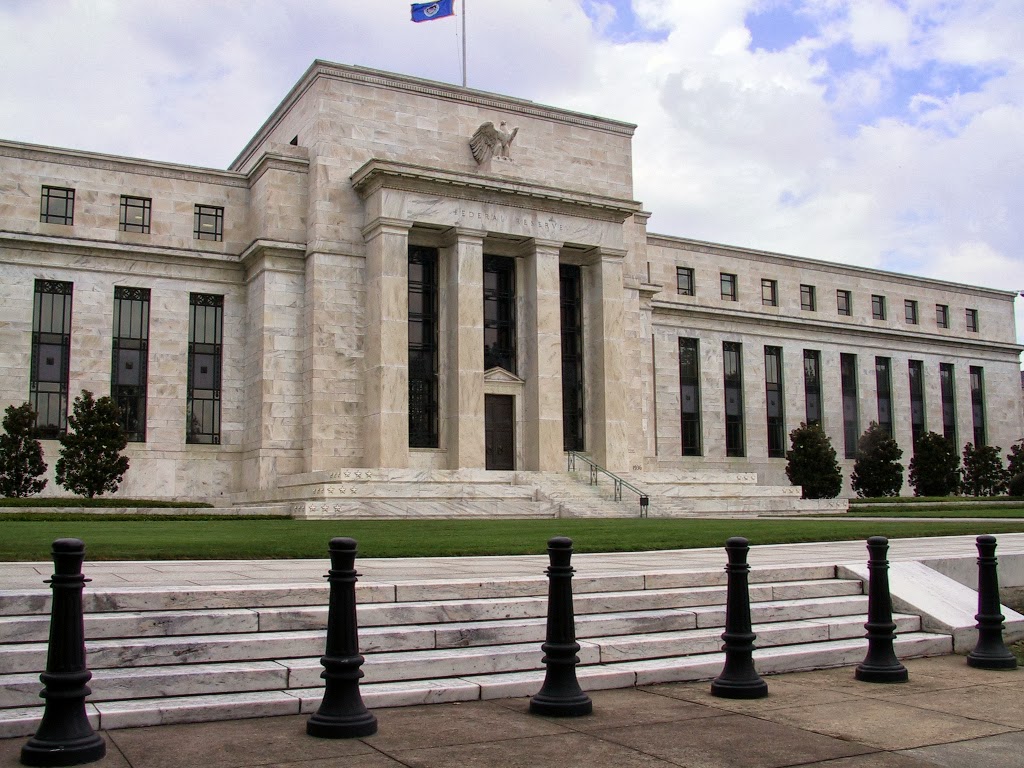
The Federal Reserve Bank has an impressive facade.
Why would the Federal Reserve do this? That's a big question, and it comes with a lot of hitches. The idea behind it is to stimulate the economy and grow the middle class. It's resulted in one of the most profound bull markets in history, and I have to say, the going has been pretty sweet. I stopped fighting the Federal Reserve in May. I likened it to a raging river threatening to sweep us all over the falls. In my metaphor, the falls is really a stand-in for "fear" that the stock market will crash and that I (along with anyone else that puts their money into the pot) will be broke and penniless. Sure that could happen. But I could also get hit by a bus crossing the street tomorrow. In the movie, "The Thirteenth Warrior" a Viking tells Antonio Banderas (who's playing an Arab) that "Fear profits a man nothing." I take that saying to heart. So to return to my metaphor of the river, there I was holding onto the branch of a tree being pummeled by the force of this huge river that wants to pull me over the falls. Hanging onto other branches with me are more middle-class Americans. However, here's where the metaphor ends. In May of this year, I let go.
The team of Fast Money talking the taper. When will it rear its ugly head?
Stocks will drop the day it does, but they'll recover. And any drop in stock
prices is just a chance to buy more. It means everything's on sale. And I
love a good sale.
I allowed myself to get thrown over the brink and into the pool at the bottom.

I didn't drown. I haven't lost my savings. In fact, my liquid assets have increased by quite a bit in five months with some shrewd investing that I did all by myself (I paid no financial advisor and I suppose I think I'm smart enough to be my own advisor).

Color me optimistic, but I don't think the U.S. economy is going to crash again for a long time. I encourage all of you that are afraid to invest to grow some balls and put some money in the stock market, whether you choose to do it through your 401K, a 457, a Roth IRA, or through the purchase of a mutual fund or carefully chosen equities. With the Federal Reserve pumping money into the economy, I think it's immune from crashing (unless the government defaults on its debt at which point we're all screwed whether or not you have stocks). And it won't last forever so ride the gravy train while you can. Sure, there will be setbacks, there will be pullbacks, and not every day is rosy on Wall Street. But if you invest for the long term (years and years) then you will reap the rewards. It's better than sitting back and watching your savings account devalue in front of your eyes. I have to say, I was sick and tired of doing that.

In retrospect, I think Ben Bernanke has been an astounding chairman for the Federal Reserve given the challenges he's faced. I think he was truly looking out for the middle class, no matter what people say about him. Sure, QE may not have worked like he intended and that's mostly because the middle class is so underrepresented in the stock market. But I have to ask myself, what other than that could the Fed have done to help the middle class? The economy is a tricky devil, and just handing out money to families might have made them put it into savings. For an economy to pull itself out of recession, there needs to be spending and not hoarding. The complexity of it sometimes boggles my mind, and I understand why there are people whose entire career is spent to try and understand the idea of money.
Will Obama nominate Janet Yellen for the job of Fed Chair? If he does, Janet
will become the first woman in history to sit in the esteemed position. That
in itself is very exciting. I think she'll do a fine job.
For the record, I think Ben's replacement is going to be Janet Yellen. She's touted as the small woman with a HUGE I.Q. Her Alma Mater is none other than U.C. Berkeley, and she served as president of the Federal Reserve bank in San Francisco. She's also one of those people that believes in keeping their thumb firmly on the print money button. Lots of people like to scoff at the Federal Reserve and say, "Ben's just printing money." Well...that's what the central bank is SUPPOSED to do. It's SUPPOSED to print money. Money is good. Liquidity is good. When the economy is flush in money it makes things work smoothly. People can get money to buy houses and to buy cars and to buy the things that they need. That's how economies work. So yeah...I hope Janet slams the "print money" button as often as she can.
Nancy Pelosi. Yeah I know you Republicans out there
absolutely hated her. For the record, I'm not a fan of
Speaker Boehner so I get it. However, I still think you
should read her op-ed on USA Today and try to
imagine how you'd react if you were told over the phone
what got said to her five years ago.
We live in extraordinary times. This is our parent's economy. We can go and blame the past generation; democrats can blame republicans and vice versa. But the fact remains, we are here and this is the way the world works right now. Extraordinary times require extraordinary messures. I don't think a lot of people understand the depths of how close capitalism came to utter destruction in 2008. Recently, former Speaker of the House, Nancy Pelosi wrote an op-ed for USA Today. In it, she said something that scared the shit out of me (you can read the full article located HERE):
Five years ago Wednesday, when I was the speaker, I gathered the other Democratic House leaders in my office to discuss the latest financial news. I told them that, as a matter of course, Treasury Secretary Henry Paulson briefed me on the state of the markets and the financial system, but had not done so that week.
In that time, Lehman Bros. had filed for bankruptcy; Merrill Lynch had faced failure and had been purchased by Bank of America; and, two days earlier, AIG had survived only after a Federal Reserve bailout.
After the meeting at 3 p.m., I placed a call to Secretary Paulson and asked him to come the next morning to brief the leadership. Then came his stunning response: "Madam Speaker, tomorrow morning will be too late."
My conservative friends, say what you will about Nancy Pelosi, but you have to admit that hearing that on the other end of the phone would be absolutely chilling. And of course, you know what followed. Congressional hearings around the clock and emergency measures to approve a trillion dollars in stimulus money because all the facts said that if the U.S. didn't do this, capitalism WOULD HAVE DIED. Our entire financial system would be in shambles. Every single one of us, red and blue, would be destitute. Children would have no future.
Billionaire investor Warren Buffett
But the stimulus alone wasn't enough. So that's where Ben and the Fed stepped in with Quantitative Easement programs to prop up the economy. There are tons of critics (and there should be because that's how democracy works). However, I've felt the power of QE myself, and I've got a new found respect for our central bank. Here's what Warren Buffett had to say of Ben Bernanke's Quantitative Easement bond-buying program:
"The Fed is the greatest hedge fund in history," Buffett told students at Georgetown University. "It's generating US$90 billion a year in revenue for the U.S. government and that wasn't the case a few years ago."
Yes, you heard that right. The math doesn't lie. QE is actually GENERATING MONEY. A LOT of money. How is the Fed doing that? Answer: tons and tons of bonds. Yes, all that bond buying they are doing to stimulate the economy that comes under heavy criticism that the Fed is borrowing from your children's future is wrong. They are INVESTING in your children's future. All of those bonds are increasing in value and paying the government back. In fact, QE may not cost this country a cent if you look at it from a certain point of view. It will make this country money. Neat, right?

It's been five years since Lehman Brothers went belly up, and I'm writing this post to thank Ben Bernanke. I think you've done a wonderful job. I don't care what the critics say. You've made me money, and in a time where scraping by is hard, that makes you a hero in my book. May your retirement from the Federal Reserve be filled with joy.

Today, I'm being interviewed over at Yolanda's blog Defending the Pen. Have a great weekend.

Friday, September 13, 2013

Are you going to buy into the twitter IPO

Disclaimer: I invest in the stock market. All of this is my own opinion. But I think it's relevant as most of you use Twitter.
The Facebook IPO started out at $38 and then tanked below $20
for a year. Will twitter do the same thing, or will it be the goose that
lay the golden egg? What do you think?
For those of you who don't trade stock, IPO stands for "Initial Public Offering" and is the day a stock "debuts" on one of the exchanges like the Nasdaq or the S&P 500. I leave the Dow out because the Dow Jones Industrial Average consists only of 30 stocks and they are notoriously selective on which stock is on their roster. To date, GE is the only company that belonged to the original Dow when it was first established. All others have been cast out. Just this week aluminum manufacturer Alcoa, tech giant Hewlett Packard, and Bank of America were thrown out/replaced by Goldman Sachs, Nike, and Visa (Wall Street considers Visa a tech company because they use technology to process payments).
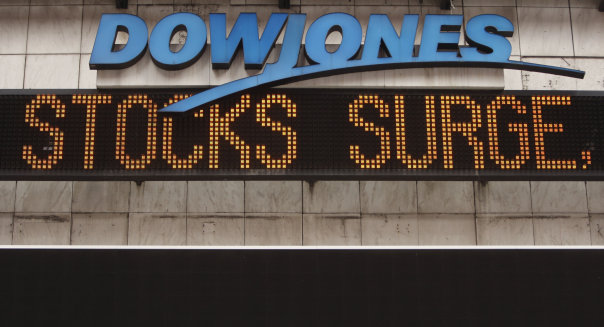
This ticker should say "30 stocks out of thousands are surging."
So whenever you hear the radio announce that the "Dow is up 100 points" or the "Dow is down 140 points", they are saying that 30 stocks out of thousands and thousands of companies in the U.S. are having a good/bad day. I usually roll my eyes and say to myself, "I could care less about the Dow. What's the Nasdaq or the S&P doing?" but I usually have to go online for that information. The Dow gets all the news.

Anyway, there's been a variety of IPO's that have soared this year. We had Noodles & Company (NDLS) that started out at $18 a share and doubled to $36 by the end of the day. Sprouts Farmer's Market (SFM) pretty much followed that same path. But I've had my eye on some that haven't gone public yet. It's a short list of companies that I'd like to try to get in on some of the early gravy although the odds are clearly stacked against me as I have no outside connections and am just a long term investor.

Presently, I own POAGX (run by Primecap) as a mutual fund mostly represented by Nasdaq equities, I own Ford (F) Motor Company (I believe in America), and I own Texas Roadhouse (TXRH-I was persuaded by the difficulty of finding a spot in their parking lot on a Friday night). I want to balance my portfolio a little better by the end of the year by either picking up a financial (Goldman), an entertainment (Lions Gate Films), a retail (Express), or a tech company (Twitter or Square sounds frickin awesome).

With the news that Twitter has filed an S-1 with lead underwriter Goldman Sachs, my interest was piqued. A date hasn't been set, but it'll probably come by Christmas. That's just in time for me to have enough money together to buy a block of shares (100), provided they are reasonably priced. Unlike Facebook, Twitter doesn't make much money. According to the news, they generate somewhere in the neighborhood of $500 million (this compared to Facebook's $10 billion). I never bought into Facebook, because I don't like it (I'm glad I didn't because their stock tanked for a year). But Twitter's a little different. I like the whole instant message feel to it and enjoy communicating with my friends and followers over Twitter. And it fills my need for a balanced portfolio by giving me a tech stock!

So I'm asking you guys out there if you are planning on buying some Twitter stock once it goes public.

If you are interested in the other initial public offerings that I have my eye on (I google them once a day to see if there's any news) here's my very very short list:
The idea behind square is absolute brilliance. Too bad there's already
copycats taking away their market share. I guess that's capitalism.
1) Square. Square makes those little white boxes you've been seeing everywhere on iPhones, iPads, and iPods that are used to take credit card payments. The idea is simple and brilliant. That's a winning strategy in my book.

2) Smashburger. Every time my friend James comes into town, he sends me a message on my iPhone that reads "Meet me at Smash." That's how much he enjoys the taste of their burgers.Their books, however, have a story that makes me salivate. 30% growth to date and a market analysis that says the U.S. could support 8000 of their restaurants.
3) Uber. On demand driver application startup called "Uber" appeals to all the millennials. In my opinion, millennials are the most entitled, spoiled rotten generation to ever walk the earth. So naturally an application that allows them to spend twice as much as a regular taxi but comes to their location in a super comfy black luxury vehicle has to be a winner. I want to own some of this company. I was so impressed by the snobbiness of Uber that I even have it featured in my book Caledfwlch (which is filled with lots of rich snobby things like Ivy League college students wearing designer clothes and ordering limousines with their smartphones). As a side note, I even feature a video game machine that cost $40,000 and looks like an egg. Seriously, if we're going to talk about how large the 1% live we might as well go far beyond Sub-zero refrigerators and Wolf appliances, right?
The name of this super-pretentious video game pod for spoiled children is "Oculas."
The price tag will kill you though. But who cares if you're a billionaire or a crook.
I guess in our country those two things are synonymous.
By the way, if you are looking for someone to talk stocks or investments with, I welcome those kinds of conversations. I read Barrons, CNBC, the Motley Fool, Seeking Alpha, and the Yahoo Finance pages as well as watch Jim Cramer on Mad Money every day of the week. I'm also not rich. I'm just trying to take the meager money I manage to scrape together and invest it wisely in things that I think will outperform my savings account interest rate (as should you).

Advertisement 1