|
Dr. Tyson exudes personality on stage. I was impressed by how entertaining,
informative, and humorous he was. And I loved it when he read from "The Book
of Carl", i.e., an honorary nod to Carl Sagan who was so important in my life
that I quote from him in my novel, Oculus (it's no coincidence that the story
takes place at Ivy League school Cornell University, Sagan's Alma Mater. |
Wednesday night at around seven o'clock mountain time, Dr. Neil DeGrasse Tyson of the Hayden Planetarium in New York City took the stage at Kingsbury Hall here at the University of Utah to thunderous applause. He immediately started talking about Pluto and how he "drove the car" that got it reclassified as a dwarf planet and how hate mail (see below) has poured into his office ever since. "I didn't fire the gun, I just drove the car." Maybe the
New York Times started it all by taking the reclassification of such notable scientists as Tyson and making an eye-catching front page headline "
Pluto's Not a Planet? Only in New York."
If you take the time to read the piece I'm talking about by following the embedded link, it's kind of humorous. Also, here's the letter that Tyson displayed behind him, and it had me laughing my ass off. In my opinion, if you're going to get hate mail, this is the best kind to get.
You gotta love any child that starts a letter in earnest with "Dear Scientist" and then goes on to be concerned about science books not being "right" and concerned about the possible people who may live there who won't exist if Pluto ceases to be a planet. I'm also fairly sure that Dr. Tyson responded to this little girl by handwritten letter (and I'd love to read that). I say this because it's simply too cute to ignore.
Tyson went on to give a summary of scientific observations about the night sky that many of us never notice (probably because we live in cities that drown out the light of the stars). For example, Uranus was originally discovered by a Brit who named the planet "George" after the English King. Really?
Thinking about the order of the planets in that way, i.e. Mercury, Venus, Earth, Mars, Jupiter, Saturn, ... and George makes me chuckle. Later it was renamed by Britain to a more suitable roman god with one concession: the moons of Uranus would be named for Greek characters that appear in Shakespearean plays (or in a poem by Alexander Pope). That's how we get Titania and Oberon (
A Midsummer Night's Dream), Ariel (
The Tempest), Umbriel (
The Rape of the Lock), Miranda (
The Tempest), Cupid (
Timon of Athens), and Mab (
Romeo and Juliet). You see, people that discover scientific things get naming rights, and this was a more fascinating topic than I thought it would be. Allow me to elaborate.
 |
Ancient Baghdad as depicted by an artist. Perhaps this might have been
a scene during the Golden Age of Islam. |
People have been looking up at the sky for a long time, and Dr. Tyson focused his lecture on a 300 year span in history known as the Golden Age of Islam. According to Dr. Tyson, Baghdad (during this era) arose as a cultural epicenter of all things scientific and wonderful.
Baghdad welcomed people from far and wide who had differing views and observations of the natural world. Arabs invented algebra and trigonometry and gave us the concept of zero (which even the Romans had no clue). They gave us words like algorithm and a numeral system we still use today. Because of the golden age of Islam humans explored biology, medicine (hospitals were open 24-hours and a system requiring medical diplomas to license doctors was put into place), and they gave us some of the most fantastic architecture and engineering the world has ever seen. And of course some people turned their eyes to the heavens to begin what would become the field of astronomy.
 |
Ibn al-Haytham was an Arab scientist,
mathematician, astronomer, and philosopher
who made significant contributions to the
principles of optics, astronomy, and the
scientific method. Before him, people used
to think we were able to see because beams
of energy emerged from our eyes. Picture
Superman and his x-ray vision and you get
the idea behind "emission theory," which
proved to be completely wrong. |
This is why most of the brightest stars in the sky have Arabic names. Betelgeuse (in the constellation of Orion) and Pollux are just two examples. But all of that scientific advancement ended
after 300 years because there was a cultural shift in the Islamic population away from scientific questioning and observation.
Tyson gave an example of this by pretending to knock something off of his podium. Instead of pursuing
why something falls to the earth and looking for a reason, the people in the region explained the event as simply being "Allah's will."
Tyson says you can't go through a day in the Muslim-centric area of the world without hearing someone make a reference to "Allah willing, the weather will be good tomorrow" or some other such nonsense. They've completely stopped their participation in forward and advanced scientific exploration and fall back upon the idea that "god did this" for all things they don't understand or don't want to understand. Religion has basically become the ultimate excuse to stop learning.
Dr. Tyson says this is a tragedy because the Muslim world comprises 1.4 billion people; that's 1.4 billion people that have washed themselves of all responsibility to make the human race better. "There have only been 2.5 Nobel Prize winners in the realm of SCIENCE that have come from Islamic backgrounds. I say .5 because one was in economics."
 |
| Imam Al Ghazali |
When Dr. Tyson frames the conversation like this, it's sobering. Literally one-sixth of the world could care less about science. So how did all of this start? He put up a picture of an Imam named Al Ghazali. A religious reformer and mystic who (in Tyson's words) is one of the people responsible for the decline of science and civilization in Muslim culture with works like
Mathematics is the work of the Devil, Al Ghazali essentially started a movement to get people to accept the following: all events had to be caused by the divine instead of being the product of some external force.
In other words, Al Ghazali killed curiosity and Tyson insists that this is going on in America today. It saddens me to agree so wholeheartedly with Dr. Tyson. Here's how I identify the problem at hand: we now have an entire population of self-absorbed scientifically unmotivated adults, and it hurts
all of us because adults are in charge. Think about it. Adults wield resources and create or destroy opportunities. In my own state of Utah, assault on education from the Eagle Forum is continuous. For example, these backward thinking conservatives want to remove sex education of any kind from the classrooms to just teach one thing: abstinence.

In my opinion, one of the biggest problems with the world today is that we have large groups of people who will accept whatever they hear on the grapevine, just because it suits their worldview--not because it is actually true or because they have evidence to support it. We live in a world where we see headlines like "
Eighty percent of the passengers who survived had studied the locations of the exit doors on takeoff." This headline doesn't provide any real information. It's not like we can ask the dead people if they studied the locations of the exit doors. And what about a congressman who (Dr. Tyson points out) said,
"I've changed my views 360 degrees on that subject!" The guy that said this makes a huge salary, yet remains scientifically and mathematically ignorant (either that or diabolically evil). We live in a world where elevators don't have a 13th floor because superstition is so powerful that people actually fear a number. And we live in a world that's afraid to use negative numbers to indicate basements. Instead we get "B" for "Basement" and "SB" for "Sub-Basement." Dr. Tyson says, "We have a perfectly established numeric system that can eliminate the need to buy a vowel."
"I don't recognize America today," Dr. Tyson said over and over. He emphasized that his reboot of Sagan's
Cosmos is an attempt to reignite America's curiosity about science. "It's to remind you of how science works." As a viewer and fan of Dr. Tyson, I have to say that
Cosmos is pretty darn amazing. Hearing him talk about future episodes of the show was exciting. But he also went on to show the audience how insignificant we really are by telling a story from his own life.
 |
Cosmos is a reboot of Sagan's mini-series filmed a
generation ago. Sadly, it will have only 13 episodes like
the original. I got the answer straight from Dr. Tyson
himself in the Q&A period (see below). |
Here's how it went down. Dr. Tyson was invited to speak before a crowd of very bright and young science and mathematics scholars who had all won awards and were headed to the colleges of their choice (boy wouldn't that be nice?).
One young man wore a Harvard tie and Dr. Tyson took the tie away from this man and asked him, "Why are you wearing this tie? Is it because you want the respect of others who recognize the pedigree of an education from Harvard?"
The young man admitted that this is exactly why he wore the tie and this is how Dr. Tyson responded: "The reason you want this is because people that went to that institution before you went out into the world and accomplished great things. After they did these great things, the institution claimed them as one of their students." Tyson eluded in his tale that many people focus on the wrong thing: an educational pedigree. "Accomplish great things and no one will care about your educational background. Does anyone here know what school Einstein went to? Do we care? Nope. He won the Nobel Prize in Science because his achievements exceeded that prize."
For those of you that may be concerned about the young man's tie, Dr. Tyson said he intends to return it to him soon and follow-up on the guy's ambitions and projects now that he's graduated.
Because I work in the public sector, this uncomfortable truth from Tyson really struck a nerve. In government, education is valued over skill (at least in the agency I work for). It has to do with justifying the expenditure of tax payer money. In order to do that, people have to have letters after their names. In the private sector, companies like Google and Facebook could care less about your education. If you have the gravitas and ability to demonstrate incredible skill in the field of software engineering, you can go to work for Silicon Valley right out of high school and make a six-figure salary. My point? Skill is prized above education.
Dr. Tyson touched on how people and their tremendous "Egos" have damaged scientific discovery. For example, many cultures raise us to believe that we are special in this universe or that we were created to rule all other things. In his opinion, this is far from the truth (as disparaging as it may be). But he went on to say that there's something deeply spiritual about being connected by DNA to all living things. I tend to agree. As an example, Dr. Tyson told the audience that there are more bacteria in your colon right now than all the people born on this world even if you go back to the very beginning of time. And every once in a while, those bacteria will remind you of who's in charge.
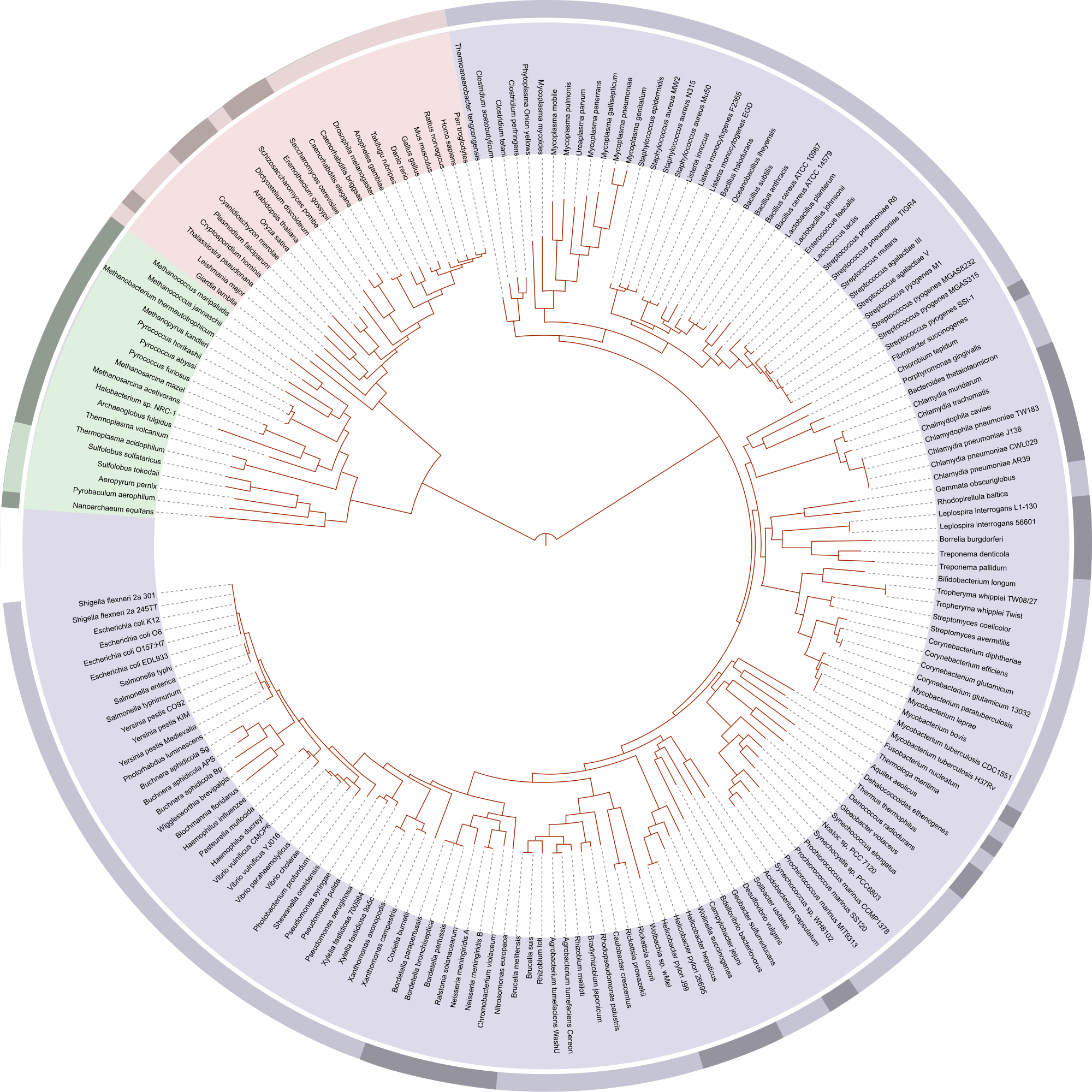
One of the slides Dr. Tyson showed the audience was a phylogenetic cross-section of a "Tree of Life" showing the relationship between species whose genomes have been sequenced as of 2006. The very center represents the last universal ancestor of all life on earth:
 |
| Click to EMBIGGEN |
Click on this sentence for an even bigger picture of the above so that you can see all the names going around the outside.
Homo sapiens occupies one small line in this list of species at about the eleven o'clock position. If that doesn't make you feel insignificant, then he followed up with a picture of Saturn taken by the Cassini spacecraft (Saturn was gorgeous by the way) that shows a pale blue dot called Earth. Then he read from Carl Sagan's own book
Pale Blue Dot: A vision of the Human Future in Space:
"Consider that dot. That's here. That's home. That's us. On it everyone you know, everyone you ever heard of, every human being who ever was, lived out their lives. The aggregate of joy and suffering, thousands of confident religions, ideologies, and economic doctrines, every hunter and forager, every hero and coward, every creator and destroyer of civilization, every king and peasant, every young couple in love, every mother and father, hopeful child, inventor and explorer, every teacher of morals, every corrupt politician, every "superstar," every "supreme leader," every saint and sinner in the history of our species lived there--on a mote of dust suspended in a sunbeam.
"The Earth is a very small stage in a vast cosmic arena. Think of the rivers of blood spilled by all those generals and emperors so that in glory and triumph they could become the momentary masters of a fraction of a dot. Think of the endless cruelties visited by the inhabitants of one corner of this pixel on the scarcely distinguishable inhabitants of some other corner. How frequent their misunderstandings, how eager they are to kill one another, how fervent their hatreds. Our posturings, our imagined self-importance, the delusion that we have some privileged position in the universe, are challenged by this point of pale light. Our planet is a lonely speck in the great enveloping cosmic dark. In our obscurity--in all this vastness--there is no hint that help will come from elsewhere to save us from ourselves.
"The Earth is the only world known, so far, to harbor life. There is nowhere else, at least in the near future, to which our species could migrate. Visit, yes. Settle, not yet. Like it or not, for the moment, the Earth is where we make our stand. It has been said that astronomy is a humbling and character-building experience. There is perhaps no better demonstration of the folly of human conceits than this distant image of our tiny world. To me, it underscores our responsibility to deal more kindly with one another and to preserve and cherish the pale blue dot, the only home we've ever known." -- Carl Sagan
Dr. Tyson showed us how America used to dream about tomorrow by putting up an image from the 1950's. I don't have a copy of the exact image Dr. Tyson used in his presentation, but it looked something like "Tomorrowland" as seen below:

He said that we no longer have these visions; that it basically ended when America stopped going to the moon. "We don't even have the ability to visit our own space station. We have to rely on Russia, which is one of the reasons why we don't want to make them too angry with sanctions over their invasion of Crimea." Again, he reiterated the theme of "I don't recognize this country." He put up a map that showed nations distorted on purpose to reflect scientific growth. You'll notice that the United States is now smaller in contribution than Japan, Europe, and China. This is a result of people electing representatives who do not value science and the thing it inoculates us from (here's looking at you Michelle Bachmann, Ted Cruz, and insane Senator Mike Lee from my own state of Utah--I hang my head in shame).
 |
| The world map of scientific growth by country. |
Notice Africa. It's non-existent. An entire area of the world that rejects science in favor of something else. Europe is huge because the United States walked away from the super collider project in the 1990's (that could have discovered the Higgs Boson not to mention made thousands of jobs for people in Texas), and we allowed the Europeans to achieve that milestone. Brazil is growing because of aerospace and Japan remains huge as it has been during the entirety of the post World War 2 generation. Tyson does not want the United States to go the way of the Golden Age of Islam.
So why should America be worried about the decline of science? Well for one, "Science inoculates you from cult leaders by giving you the tools to question their authority." He described how the Heaven's Gate cultists all committed suicide because they believed a spaceship was traveling behind the comet Hale-Bopp and that (through dying) they'd arrive on the spaceship wearing their shoes and carrying their backpacks. In every generation there are people who claim the world is ending and they base it on some lie that has no evidence. Science gives you the ability to question these claims. "Oh you say there's a spaceship? Can you show it to me?"
 |
The vest he's wearing was bought right here at the planetarium in Salt
Lake City. He said there were no more on the shelves and the guy
working the register had one on and offered to sell it to him. It remains
one of the most favorite of his vests to wear. |
In the question and answer session, I actually got to ask Dr. Tyson a question. Boy was that fun. I said, "Dr. Tyson, will there be a second season of
Cosmos?" He reacted with a huge smile and capered about the stage comically. "DO YOU HAVE ANY IDEA HOW HARD IT WAS TO GET THE FIRST SEASON to television!? Holy cow. I don't know. It's up to Fox, but as much as I love it someone else needs to do it. I'M A SCIENTIST. I want to be in my lab and watching my kids grow up." He shook his head to many affectionate "awhh's" coming from the audience (including my own) and replied, "Folks, that's how it works. Someone else gets to take over. We pass the baton to someone new."
Well I asked a question and got an answer. I love
Cosmos, but it appears there will be only thirteen episodes just like Sagan's mini-series that was on PBS a generation ago. I guess I will have to savor them. TL;DR: I saw Neil DeGrasse Tyson live at the University of Utah and he made me dream about tomorrow. It's a dream I haven't had in some time, and I'm glad it's back.
Do you think the United States can turn itself around, get a hold of education, and instill the love of science in the next generation? Do you think the first man on Mars will be an American? I'd like to think so, but Neil DeGrasse Tyson is right. Only science will show us the way.